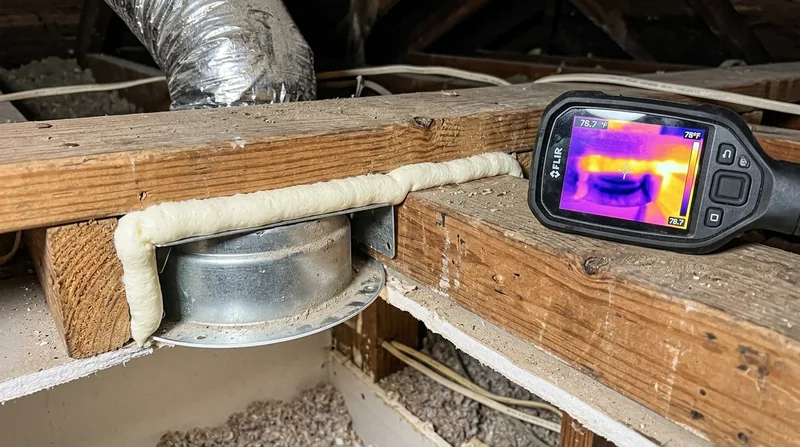




Houston's vented attics leak cooled air through top plates, recessed can lights, ductwork chases and roof hatches long before insulation R-value matters. Sealing those penetrations first is the single cheapest comfort fix in the region, and the step that separates a real insulation job from a surface application. Air sealing in Houston stops the flow at the source, turning every R-value you add into actual cooling performance. From the slab-on-grade subdivisions of Katy and Sugar Land to the pier-and-beam crawl spaces of The Heights and Montrose, every attic that bakes at 130 to 150 degrees from May through October needs this work done right. We've been sealing leaks and insulating since 2012, and the homes that stay cool longest are the ones where we sealed first.
Why Air Sealing Matters in Houston's Hot-Climate Attics
A typical Houston attic loses cooled air through dozens of small and medium openings that fiberglass or blown-in insulation cannot seal. Top plates where walls meet the attic floor, recessed can lights that punch through the ceiling, HVAC chases and ductwork penetrations, attic access hatches, and gaps around plumbing vent stacks all bleed conditioned air into the unconditioned space above. In summer, when outdoor temperature sits 20 to 30 degrees above your thermostat setting, that leak becomes a direct thermal pathway, and your air conditioning runs longer and harder to compensate. Sealing these leaks before insulating ensures the R-value actually performs, rather than being bypassed by air movement.
- Identify and seal all penetrations in the attic floor before adding or upgrading insulation.
- Use spray foam, foam board, and caulk to create a continuous air barrier around electrical, mechanical and structural openings.
- Verify that all sealing work meets code thermal and ignition barrier requirements for your address.
- Test the sealed envelope with visual inspection to confirm no air pathways remain open to the attic.
This sequence is why sealed attics outperform vented ones in Houston, and why we always seal before we insulate.
Key info: Houston's building code requires a thermal barrier on foam applied to the underside of roof decks and a fifteen-minute thermal barrier on foam in walls and attics. The local building official enforces these rules at your address, not the insulation contractor. Always confirm what applies before work begins.
For more detail on how sealed attics work, see our attic spray foam insulation service page.
How We Seal Air Leaks in Houston Attics: Step by Step
We start with a walk-through of your attic to map every penetration, light fixture, chase, duct and opening. We photograph the existing condition and note where air is moving visibly or by feel. Then we seal each opening methodically, using spray foam on large gaps, closed-cell foam on rim and band joists, foam board on ductwork chases, and caulk on smaller cracks and joints. The goal is a continuous air barrier that stops thermal bypass, so your insulation can do its job. Once sealing is complete and cured, we verify the work visually and prepare the space for insulation installation or upgrade.
- Walk the attic and document all penetrations, light fixtures, ductwork chases, and gaps in the floor.
- Seal top plates and band joists with spray foam to create a continuous air barrier.
- Close off recessed can lights, plumbing vents, and electrical chases with foam board or caulk.
- Seal all ductwork penetrations and HVAC chase openings before insulation is installed.
- Allow all foam and caulk to cure fully before re-entry or insulation application, typically 24 to 48 hours.
The result is an attic that breathes as a sealed system, not as a leaking envelope.
Real example: A 1960s brick ranch in Spring had an original fiberglass attic that had compressed to R-8 over fifty years. The homeowner added blown-in insulation, but the cooling bill barely moved because air was leaking around the top plates and through the ductwork chase into the attic. We sealed the top plate with closed-cell foam, capped the chase, and sealed around the recessed lights. Then the new blown-in insulation actually worked, and the bill dropped noticeably.
Learn more about closed-cell spray foam insulation for sealing rim joists and band joists.
Air Sealing Methods and When to Use Each
| Approach | Description | Best for |
|---|---|---|
| Closed-cell spray foam | High-density foam that expands to fill gaps and hardens into a rigid air barrier. Typically 1 to 2 inches thick on band joists and rim areas. | Top plates, band joists, rim joists, and large irregular gaps where you need both air sealing and insulation value. |
| Foam board and caulk | Rigid foam panels cut and fitted into chases and around light fixtures, sealed at edges with caulk or foam sealant. | Ductwork chases, recessed can light openings, and plumbing vent penetrations where you need a clean, finished air barrier. |
| Spray foam sealant and caulk | Lower-expansion foam sealant applied to smaller cracks, joints, and gaps. Cured foam is cut and painted if exposed. | Electrical outlet boxes, small gaps in framing, joints between existing insulation batts, and minor penetrations. |
| Gaskets and weatherstripping | Adhesive-backed foam or rubber seals applied to the edges of attic access panels and hatch frames. | Attic hatches and pull-down stair openings where a removable air barrier is needed and repeated access is required. |
Each method is chosen based on the size, shape and location of the opening, the code requirements for your address, and whether the sealed area will be insulated over or left visible.
Air Sealing Cost in Houston: What to Expect
Air sealing in Houston typically starts at $650 for a single-story home with a straightforward attic layout and a moderate number of penetrations. The cost moves upward based on attic size, the number and complexity of openings to seal, access difficulty, and whether you are sealing only or sealing plus insulation upgrade. A two-story home with a larger attic, multiple HVAC chases, recessed lighting, and plumbing vents will cost more than a simple ranch with fewer penetrations. Homes in Cypress, The Woodlands, or Sugar Land with newer construction and sealed roof decks may have fewer air leaks to seal, while older stock in The Heights or Montrose may require more extensive work.
The best way to know your actual cost is a free on-site estimate. We measure the attic, count the penetrations, assess access, and give you a written quote with R-value and thickness specifications so you understand exactly what you are paying for. Most estimates are completed within 24 hours, and there is no obligation to book. Call us at (346) 322-2588 or visit our pricing page for more detail on what affects the final number.
Getting 2 to 3 estimates from different contractors is smart. Make sure each estimate includes the scope of sealing work, the materials to be used, and the R-value and thickness of any insulation to be added. Avoid estimates with no detail, no R-value listed, or a price far below the market rate, as these often signal corners cut or work left incomplete.
What to Look for When Hiring an Air Sealing Contractor Near Me in Houston
The spray foam and air sealing trade in Houston includes local independent shops, national franchise operations, and rig-and-run crews from out of state. The local independent is positioned against both because we are reachable, we stand behind the work, and we know the building codes that apply at your address. Before you hire anyone, verify that they are fully insured and that their insurance covers spray foam application and air sealing. Ask for a certificate of insurance and confirm the coverage limits with the carrier if you have concerns. Get a written estimate that names the materials, specifies thickness and R-value, and breaks down labor and material costs so you can compare apples to apples.
- Confirm that the contractor is fully insured for spray foam and air sealing work, and request a certificate of insurance before work begins.
- Ask whether the estimate includes mechanical ventilation during cure and a stated re-entry window of 24 to 48 hours.
- Verify that the contractor understands your local building code and will confirm with the building department what thermal barrier and ignition barrier requirements apply at your address.
- Check references from recent Houston-area jobs and ask about the contractor's response time if issues come up after the work is done.
- If your home is in an HOA community or a historic district, confirm that the contractor understands any architectural or permitting rules that apply to exterior work.
The strongest signal of a professional operation is a detailed estimate with no pressure, transparency about what will happen during cure, and a clear warranty on workmanship. For a free estimate and to discuss your specific project, contact us at (346) 322-2588. We serve Houston, Katy, Sugar Land, The Woodlands, Pearland, Spring, Cypress, Conroe, League City, and surrounding areas.
Air Sealing in Houston: Pricing Guide
| Service | Price | Details |
|---|---|---|
| Single-story attic air sealing | Starting at $650 | Includes sealing top plates, light fixtures, and minor penetrations in straightforward attic layouts |
| Two-story home with multiple chases | Starting at $1,200 | Larger attic footprint, HVAC chases, recessed lighting, and plumbing vents require more material and labor |
| Air sealing plus insulation upgrade | Starting at $2,100 | Sealing all penetrations, then adding blown-in or spray foam insulation to achieve target R-value for your attic |
| Complex retrofit or large commercial space | On estimate | Sealed roof decks, metal buildings, or extensive existing insulation removal require site measurement and detailed scope |
| Travel | Included | No separate mileage or travel fee for service areas in Houston and surrounding Greater Houston region |
| Free estimate | No charge | Written estimate with R-value and thickness specs provided within 24 hours at (346) 322-2588 |
Indicative pricing, the exact cost depends on square footage, finish, and site access. Free personalized estimate within 24h at (346) 322-2588.


