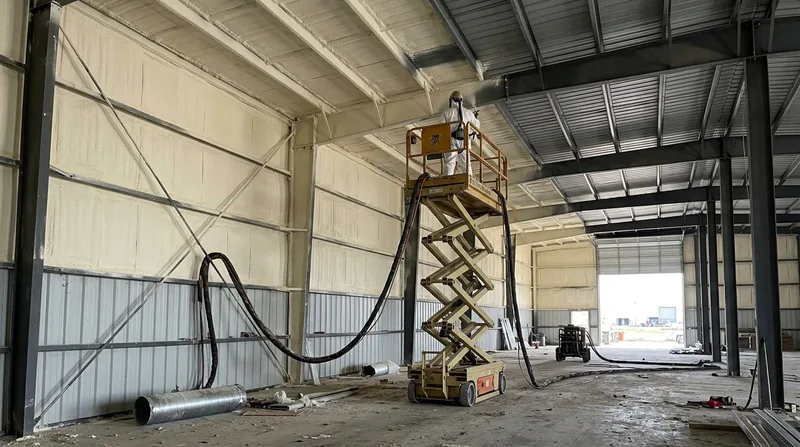




Commercial and new construction spray foam insulation in Houston is the standard for warehouses, office shells, churches and production-builder homes where sealed attics and conditioned roof decks are now expected by code and by the market. The Houston region builds tens of thousands of new homes a year, and across the Energy Corridor, the Ship Channel and the sprawling master-planned belts from Katy to League City, the demand for code-compliant, inspector-ready foam assemblies on schedule is constant. We work phased jobs that keep your operation running, and we deliver documentation that your building official will actually accept. From new construction framing to existing commercial shells, we seal and insulate the way the code requires it.
Why Commercial and New Construction Spray Foam Matters in Houston's Building Boom
Houston's flat Gulf Coast terrain and year-round construction cycle mean that sealed attics and foam-encapsulated roof decks are no longer optional. The region's brutal summer heat, 90%+ humidity and hurricane-season moisture drive every insulation decision, and vapor drive runs from the outside in. New construction that leaves a vented attic or an uncontrolled crawl space is leaving money on the table from day one, and commercial tenants expect thermal performance and indoor air quality that fiberglass and blown-in cellulose simply cannot deliver. Sealed assemblies with closed cell foam stop condensation and moisture infiltration before they start, and they hold their R-value year after year without settling or degradation.
- We deliver code-compliant assemblies with written R-value and thickness specifications that your building department will accept without pushback.
- We phase work around your construction schedule so framing, electrical and mechanical trades stay on time.
- We handle the thermal barrier and ignition barrier requirements that vary by city and by the building official at your address.
- We document every job so your inspector has the paperwork before the final walkthrough.
- We work new construction and existing commercial shells with the same attention to ratio, temperature and cure ventilation that separates a professional installation from a rig-and-run crew.
The difference between a sealed, foam-encapsulated attic and a vented one in Houston is the difference between a building that holds its value and one that sweats money away every summer.
Key info: Houston's energy and building code is enforced by the local building official at your address, and the fifteen-minute thermal barrier requirement is the one most generalist crews get wrong. We name it correctly and build it right the first time. Always verify your city's specific permit and registration requirements with your local building department.
For more on how sealed attics compare to vented ones, see our attic spray foam insulation page.
How We Deliver Commercial and New Construction Spray Foam on Schedule
Every commercial and new construction job starts with a site walk and a clear scope. We measure the attic or roof deck, confirm the foam type and thickness your code requires, identify any existing moisture or substrate issues, and give you a timeline that fits your construction schedule. We bring our own air handling and ventilation so cure happens in a controlled environment, and we stay on site until the space is safe for re-entry. No shortcuts, no immediate occupancy promises, no smell that won't go away.
- We inspect the substrate for moisture, leaks or contamination and walk away if it is not dry and clean.
- We set up mechanical ventilation and air handling before we spray a single board foot.
- We apply foam in controlled passes at the manufacturer's specified ratio and drum temperature so thickness is uniform and density is correct.
- We apply the thermal barrier and ignition barrier as your code requires, and we document the installation with photographs and R-value certification.
- We provide a re-entry window of 24 to 48 hours and written guidance on post-cure conditions before mechanical systems are turned on.
On a new construction warehouse in the Energy Corridor or a production builder's sealed attic in Sugar Land, the process is the same: measure, plan, seal the substrate, ventilate, spray, barrier, document, walk away clean.
Real example: A new 40,000 sq ft office shell in Pasadena with a sealed roof deck needs 4 inches of closed cell foam, a 15-minute thermal barrier and mechanical ventilation during cure. We schedule the work between drywall and final inspection, bring in our own HVAC trailer, and deliver documentation that the building official needs before sign-off. The job takes 3 to 4 days depending on weather and crew size, and the building is ready for HVAC and electrical by week's end.
For details on how we handle existing commercial structures, see our metal building and barndominium spray foam page.
Commercial and New Construction Spray Foam Methods and Materials
| Approach | Description | Best for |
|---|---|---|
| Closed Cell Spray Foam | High-density foam (1.5 to 2.0 lb/cu ft) with an R-value of 6.0 to 6.5 per inch. Stops vapor transmission, resists moisture infiltration, and holds its R-value indefinitely. Requires mechanical ventilation during cure and a 24-hour re-entry window. | Sealed attics, roof decks, crawl spaces, and any assembly where moisture control is critical. Standard for new construction in Houston. |
| Open Cell Spray Foam | Low-density foam (0.4 to 0.5 lb/cu ft) with an R-value of 3.5 to 3.8 per inch. Vapor permeable, lighter weight, and lower cost. Cures faster and is easier to cut and fit around obstacles. Not recommended for exterior or moisture-exposed applications. | Interior attics and walls where vapor permeability is acceptable and cost is a primary driver. Sound dampening in office interiors. |
| Injection Foam Retrofit | Low-pressure injection foam applied through small holes in existing walls, band joists or rim joists without demolition. Fills cavities and seals air leaks in place. Requires careful pressure control to avoid structural damage. | Existing commercial walls, masonry cavities, and rim joist sealing where demolition is not an option. |
| Attic Deck and Roof Encapsulation | Closed cell foam applied directly to roof decking or attic framing, sealed edge-to-edge to create a continuous thermal and air barrier. Includes thermal barrier and ignition barrier installation per code. Eliminates the need for soffit and ridge vents. | New construction and retrofit sealed attics. The standard for high-performance homes and commercial buildings across Houston. |
Commercial and New Construction Spray Foam Cost in Houston: What to Expect
The cost of commercial and new construction spray foam insulation depends on the foam type, the thickness required by your code, the size of the area, and the substrate condition. A new construction sealed attic in a production-builder home in Katy or Cypress runs differently than a 50,000 sq ft warehouse shell or a retrofit of an existing commercial building. We start with a free commercial estimate that covers the scope, the R-value, the thickness, and a realistic price based on your specific site conditions. Travel is included in Houston and surrounding areas, and we respond within 24 hours at (346) 322-2588.
Closed cell foam, the standard for sealed attics and commercial shells, typically ranges from $1.50 to $2.50 per board foot installed, depending on thickness, accessibility, and whether mechanical ventilation is required. A 1,200 sq ft attic at 4 inches of closed cell foam is roughly 400 board feet, which puts the job in the $600 to $1,000 range before any existing insulation removal or air sealing. Open cell foam is less expensive per board foot but requires more thickness to achieve the same R-value, so the total cost is often comparable. Injection foam retrofit into existing walls is priced per linear foot of cavity and is typically the lowest-cost air sealing option for masonry and band joist work.
The biggest cost drivers are substrate preparation (removal of existing insulation, moisture remediation, or structural repairs), the thermal and ignition barrier materials required by your local code, and the complexity of the assembly (multiple levels, cathedral ceilings, or tight mechanical spaces all increase labor time). A detailed, site-specific estimate is the only honest way to price the work. See our full pricing page for ranges and examples, and call us at (346) 322-2588 for a free estimate with no obligation.
What to Look for When Hiring a Commercial and New Construction Spray Foam Contractor Near Me in Houston
The spray foam market in Houston includes local independent shops, national franchise operations, and rig-and-run crews that spray a job in an afternoon and disappear. The difference is visible in the estimate, the installation, and the paperwork you hold afterward. A professional contractor will give you a written estimate with R-value and thickness specifications, will explain the code requirements at your address, will provide proof of insurance that you can verify, and will leave you with documentation that your building official will accept without questions.
- Ask for a written estimate that specifies the foam type, the R-value, the thickness per pass, and the total board feet to be applied.
- Verify that the contractor carries general liability insurance and can provide a current certificate of insurance naming your project.
- Check references from at least two previous commercial or new construction projects in your city or a neighboring area.
- Confirm that the contractor understands the thermal barrier and ignition barrier requirements that apply at your address, and ask for proof that previous jobs passed inspection.
- Ask about post-cure ventilation and the re-entry window, and verify that the contractor will not promise immediate occupancy.
- If your project is in a master-planned community or HOA, confirm that the contractor understands any architectural or exterior restrictions that apply to metal buildings or additions.
The contractor you hire should be reachable after the job is done, should stand behind the workmanship, and should answer your questions about smell, timing and cure conditions without defensiveness. If an estimate has no R-value and no thickness, if the price is far below market, or if the contractor promises immediate re-entry and zero smell, walk away. For a free, no-obligation estimate and a conversation with someone who knows the Houston code, contact us here or call (346) 322-2588.
Commercial & New Construction Spray Foam in Houston: Pricing Guide
| Service | Price | Details |
|---|---|---|
| Free commercial estimate | Free | Site walk, scope definition, R-value and thickness specs, and realistic pricing within 24 hours |
| Closed cell spray foam, new construction attic | Starting at $1.50 to $2.50 per board foot | Sealed attic or roof deck, 4 to 6 inches, thermal and ignition barrier included, code-compliant documentation |
| Open cell spray foam, interior attic or wall | Starting at $0.90 to $1.50 per board foot | Interior applications only, 5 to 8 inches for equivalent R-value, faster cure, lower cost than closed cell |
| Injection foam retrofit, band joist or rim joist | Starting at $3.00 to $5.00 per linear foot | Cavity fill without demolition, pressure-controlled application, includes air sealing of rim and band joists |
| Substrate preparation and existing insulation removal | On estimate | Varies by volume and contamination level; moisture remediation or structural repair quoted separately |
| Travel and setup | Included | No separate mileage or travel fee in Houston and surrounding service areas |
Indicative pricing, the exact cost depends on square footage, finish, and site access. Free personalized estimate within 24h at (346) 322-2588.


