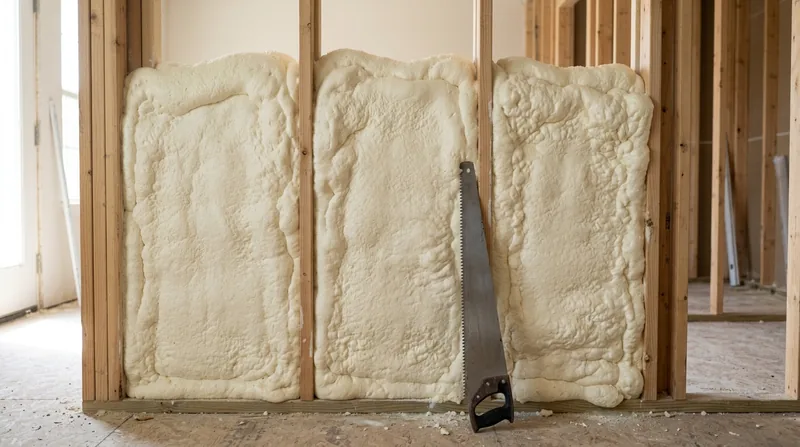




Open Cell Spray Foam Insulation in Houston is the price-friendly answer to attic and wall air sealing in a climate where vented attics bake at 130-150°F from May through October and humidity drives condensation year-round. Half-pound open-cell foam costs less per board foot than closed-cell foam, delivers genuine R-value (typically 3.6 per inch), and adds sound dampening as a bonus, making it the right fit for attic top-ups, bonus rooms, and interior wall cavities where moisture is not the primary threat. Houston's flat sprawl of slab-on-grade neighborhoods, 1950s-70s brick ranches with failed insulation, and newer two-story stock in Katy, Cypress, The Woodlands and Pearland all run hot attics that leak conditioned air into unconditioned space. We size the job on site, specify R-value and thickness in writing, control the spray in a single pass per lift, and seal the thermal envelope so your cooling system does not fight a losing battle. Open cell is not the answer everywhere, metal buildings, crawl spaces, and rim joists where vapor drive runs inward demand closed-cell spray foam, but in the right application, it saves money without cutting corners.
Why Open Cell Spray Foam Matters in a Houston Attic
A vented attic in Houston gains heat through the roof deck, loses conditioned air through gaps in the framing, drywall and penetrations, and forces your air conditioner to run harder than it should. Open-cell foam seals those gaps, stays flexible as the structure moves with temperature swings, and does not trap moisture the way fiberglass batts do when humidity seeps in from below. The foam cures to a semi-rigid state, bonds to wood, metal, and drywall, and once cured (typically 24 to 48 hours with proper ventilation during application) it is inert and low-VOC. In Houston's heat and humidity, an air-sealed attic with open-cell foam keeps ductwork cooler, reduces the load on your compressor, and eliminates the stratification that makes upstairs bedrooms hot while downstairs stays cold.
- Open-cell foam expands to fill irregular cavities, sealing around electrical boxes, HVAC penetrations, and framing gaps that fiberglass leaves open.
- The material absorbs sound, dampening the hum of ductwork and reducing noise transmission between floors in two-story homes.
- Lower density (half-pound) means easier handling than closed-cell and a lower installed cost per board foot across the whole attic.
- Vapor-permeable foam allows any moisture that enters the attic to dry toward the interior, rather than trapping it in the foam itself.
- We spray in a single controlled pass, measuring thickness on site and stamping the invoice with R-value so you have proof of what was installed.
These factors combine to make open-cell the natural choice for attic air sealing in Houston neighborhoods where the roof deck is sound, ventilation is not compromised, and the goal is efficiency without the premium of closed-cell.
Key info: Houston attics in Meyerland, Braeswood, Spring Branch and The Heights often carry 50-year-old batts that have settled to R-2 or R-3 and no longer seal. Open-cell foam retrofitted over the existing insulation (without removal) restores the air seal and adds R-12 to R-18 depending on thickness, cutting cooling bills by 15 to 25 percent in typical cases.
For more on how we seal attics, see our Attic Spray Foam Insulation service page.
How We Install Open Cell Spray Foam in Your Home
We start with a walk-through to assess the attic or wall cavity, check for moisture, leaks, or contamination, and measure the space to calculate board footage. We prepare the work area, run mechanical ventilation during the spray (a safety and quality step that separates professionals from rig-and-run crews), and apply the foam in a single controlled pass at the correct drum temperature and mix ratio. Once cured, we inspect the coverage, photograph the thickness, and document the R-value on your invoice. The whole process, from prep through re-entry window, typically takes one to three days depending on attic size and complexity.
- We verify the roof deck and framing are dry and sound before we spray; if moisture or active leaks are present, we do not proceed.
- Mechanical ventilation runs during application and curing to manage fumes and ensure proper cure; re-entry is safe after 24 to 48 hours with no odor.
- We seal around HVAC ducts, electrical penetrations, and band joists before the main attic spray so gaps do not get missed.
- Thickness is measured and recorded for every section, and R-value is stamped on the invoice so you have documentation for insurance or resale.
- We clean up debris and leave the attic ready for use; no lingering smell or safety hazards if the job is done right.
This systematic approach is why homeowners in Cypress, Pearland and League City call us back for other insulation work: they know the job is done once, done right, and documented.
Example: A 1,200-square-foot attic in Sugar Land with 4 inches of settled fiberglass takes roughly two days to spray with 3 inches of open-cell (bringing total to 7 inches, or R-25 to R-27). Cost runs from $2,000 to $3,200 depending on access and penetration density; the homeowner receives a written estimate with R-value and thickness before work begins.
Learn more about our Air Sealing service and how it complements spray foam.
Open Cell vs. Closed Cell vs. Blown-In: Which is Right for Your Houston Home?
Open-cell foam is the right tool for attics and interior walls where vapor is not the primary concern and cost matters. Closed-cell foam is denser, carries higher R-value per inch, and stops vapor drive, making it essential for crawl spaces, metal buildings, and rim joists where condensation kills insulation and structure. Blown-in fiberglass is sometimes the right answer for a simple attic top-up over sound insulation, and we will tell you so if that is what your attic needs. The decision is driven by use, not by what sounds fancier or more expensive.
| Approach | Description | Best for |
|---|---|---|
| Open-Cell Spray Foam | Half-pound density, R-3.6 per inch, vapor-permeable, sound-dampening, lower cost per board foot. | Attic air sealing, bonus rooms, interior wall cavities, two-story homes in Katy and The Woodlands where heat gain through the roof is the main problem. |
| Closed-Cell Spray Foam | Two-pound density, R-6 to R-7 per inch, vapor barrier, highest cost per board foot, stops condensation and moisture drive. | Crawl spaces, metal buildings, barndominiums, rim and band joists, sealed attic decks where vapor control is non-negotiable. |
| Blown-In Fiberglass or Cellulose | Loose-fill, R-2.5 to R-3.5 per inch, no air sealing, lowest cost, settles over time. | Top-up of existing sound attic insulation when air sealing is not the goal and budget is tight. |
| Insulation Removal and Replacement | Old batts, settled fiberglass, or failed foam removed and disposed of; new foam or blown-in installed in its place. | 1950s-70s brick ranches in Spring Branch, Braeswood and Meyerland where original insulation is flattened and no longer performs. |
We do not assume; we measure, assess the failure mode, and recommend the method that solves your actual problem without overselling.
Open Cell Spray Foam Insulation Cost in Houston: What to Expect
Open-cell spray foam in Houston typically starts at $0.55 to $0.75 per board foot for material and labor, depending on attic size, access, penetration density, and how much existing insulation must be worked around. A 1,200-square-foot attic sprayed with 3 inches of open-cell (roughly 300 board feet) runs $1,650 to $2,250 before any removal or prep work. Larger attics and homes in Pasadena, Humble or Tomball with easier roof access may run lower; tight crawlways, multiple HVAC chases, or removal of old insulation push the cost up. We always provide a written estimate with thickness and R-value specified, so you know exactly what you are paying for before we start.
Factors that move the price include attic size (linear relationship), access difficulty (stairs, hatches, or need to work from the roof), penetration density (HVAC ducts, electrical boxes, plumbing vents all require careful sealing), and whether old insulation stays or must be removed first. Two or three estimates from different contractors let you compare not just price but also R-value, thickness, and warranty language. The cheapest bid is often the one with no R-value stamped, no thickness documented, and a promise of immediate re-entry, red flags for a crew that is cutting corners.
See our full pricing page for attic, wall, and specialty foam costs across Houston and surrounding areas.
Open Cell Spray Foam Insulation Near Me: What Houston Homeowners Should Know When Hiring
The spray foam trade has two extremes: national franchises with crews from out of state and rig-and-run outfits that spray an attic in an afternoon and vanish when the smell will not go away. A local contractor with a local address, local crew, and local insurance is the middle ground, accountable to the community, reachable if something goes wrong, and invested in the work lasting. When you call, ask for a written estimate with R-value and thickness on every section, proof of insurance (we are fully insured), and references from jobs in your neighborhood. Verify that mechanical ventilation will run during the spray and cure, and that re-entry is not promised sooner than 24 to 48 hours. Ask about the warranty on workmanship (typically one to three years) and whether the estimate includes a site inspection or is just a phone guess.
- Get at least two or three estimates from contractors who will walk your attic and measure, not quote over the phone.
- Verify insurance coverage with the contractor's agent; ask for a certificate of insurance naming your address.
- Ask whether the contractor pulls permits if required by your city (Houston, Katy, Sugar Land and other cities have different rules).
- Check references from recent jobs in your zip code, not just testimonials on the website, but actual homeowners you can call.
- Confirm that the estimate includes a written R-value and thickness spec, and that the invoice will show what was actually installed.
- Ask about the re-entry window and whether mechanical ventilation is part of the standard process; immediate re-entry is a sign of inadequate curing or ventilation.
These steps protect you from surprises and ensure the job is done by someone who will be there to stand behind it.
Ready to get started? Contact us for a free estimate. Call (346) 322-2588 or fill out our online form for a response within 24 hours. We serve Houston, Katy, Sugar Land, The Woodlands, Pearland, Pasadena, Spring, Cypress, Conroe, League City, Baytown, Missouri City, Friendswood, Humble, Tomball, Rosenberg, Texas City, Galveston, Magnolia and Alvin.
Open Cell Spray Foam Insulation in Houston: Pricing Guide
| Service | Price | Details |
|---|---|---|
| Open-Cell Spray Foam (Attic or Wall) | Starting at $0.55/board ft | Material and labor; cost varies with attic size, access difficulty, and penetration density (HVAC ducts, electrical boxes) |
| Small Attic (800-1,000 sq ft) | Typically $1,200-$1,800 | 3 inches of open-cell foam over existing insulation; includes air sealing and documentation of R-value and thickness |
| Medium Attic (1,200-1,500 sq ft) | Typically $1,800-$2,800 | 3 to 4 inches of open-cell; includes removal prep, ventilation during cure, and written R-value certification on invoice |
| Insulation Removal (if needed) | On estimate | Old fiberglass or failed foam removed and disposed of before new foam is sprayed; cost depends on volume and disposal requirements |
| Travel | Included | No separate mileage or call-out fee within Houston and surrounding service areas |
| Estimate | Free | Written estimate with R-value and thickness specs; response within 24 hours at (346) 322-2588, no obligation to book |
Indicative pricing, the exact cost depends on square footage, finish, and site access. Free personalized estimate within 24h at (346) 322-2588.


