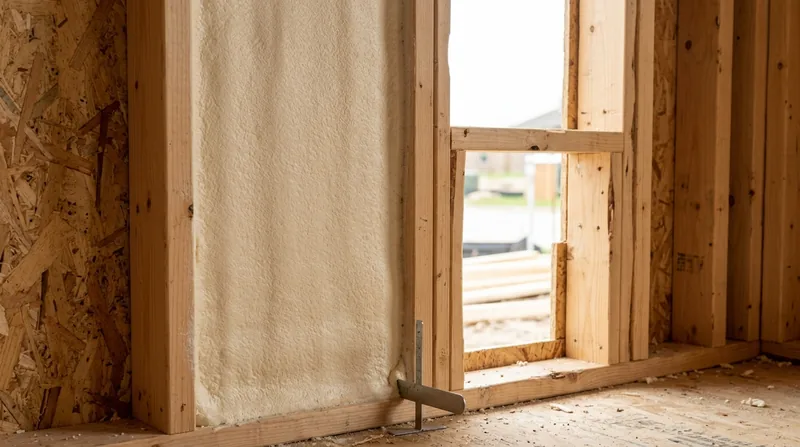




Closed cell spray foam insulation in Houston is the high-performance answer to the Gulf Coast's relentless heat and humidity. Houston sprawls across flat slab-on-grade neighborhoods where vented attics bake at 130 to 150 degrees Fahrenheit from May through October, and that thermal load drives cooling bills higher every year. Closed cell foam delivers R-6.5 per inch, its own vapor barrier, and structural stiffening in a single application, making it the right choice for metal buildings, exterior walls, and anywhere moisture pressure runs hardest. Whether you own a ranch in Meyerland, a two-story in Katy, or a metal shop out past Magnolia, closed cell foam stops air leakage and vapor drive before they become repair bills. We have been spraying foam in Greater Houston since 2012, and we know what works on this coast.
Why Closed Cell Spray Foam Matters in Houston's Hot, Humid Climate
Houston sits at the intersection of brutal summer heat and Gulf moisture. Your attic doesn't just lose cooled air through gaps and seams, it also absorbs moisture from the outside in, which degrades fiberglass insulation, feeds mold, and corrodes ductwork. Closed cell foam solves both problems at once: it seals every air leak, creates its own vapor barrier, and resists the moisture that flattens blown-in batts within a decade. The difference shows up in your electric bill and in the durability of your home's structure.
- Closed cell foam stops air infiltration completely, eliminating the single largest source of cooling loss in vented attics.
- Its closed-cell structure acts as a vapor barrier, blocking moisture from entering the insulation or condensing on roof decking.
- The foam adds structural rigidity to walls, roofs, and metal building frames, which matters in hurricane season.
- Unlike fiberglass, it does not settle, compress, or lose R-value over time in Houston's heat cycles.
- It works equally well in retrofit applications on existing homes and in new construction where sealed attics are becoming standard.
These properties are why closed cell foam is the industry standard for metal buildings, pole barns, and barndominiums across the Energy Corridor and the rural acreage belt where condensation would otherwise drip from steel framing.
Key info: Houston's building code, enforced by the local building department at your address, governs attic ventilation and thermal barrier requirements. Closed cell foam on a sealed attic deck eliminates the need for soffit vents and the air leakage they permit, but the code officer has the final word on what applies to your home. We help you navigate what your city requires, and we defer to the building official.
For more detail on how closed cell compares to open cell foam, see our open cell spray foam insulation page.
How We Install Closed Cell Spray Foam in Houston Homes and Buildings
Closed cell foam installation is a precision process. The foam is mixed on-site from two-part resin and hardener, heated to the correct temperature, and sprayed through a calibrated gun in controlled passes. The thickness and density matter absolutely: too thin and you lose R-value, too thick and you risk moisture trapping. We spray to the R-value and thickness specified in your written estimate, and we use mechanical ventilation during cure to manage VOC off-gassing. Re-entry is typically safe after 24 to 48 hours, depending on thickness and ambient conditions.
- We inspect your attic, walls, or crawl space and identify all air leakage points and moisture sources before we spray.
- We remove old insulation if it is failed, wet, or contaminated, and we do not spray over a wet or leaking substrate.
- We set up mechanical ventilation to exhaust fumes and control humidity during the cure period.
- We spray closed cell foam in multiple thin passes to achieve the target thickness and density without trapping moisture.
- We verify thickness with a depth gauge and document R-value and coverage in your final report.
- We secure re-entry access and explain the cure window before you re-occupy the space.
This step-by-step approach is what separates a professional installation from a rig-and-run crew that sprays in an afternoon and disappears when the smell won't go away.
Example: A homeowner in Spring with a 1,400-square-foot attic over a bonus room needed R-30 closed cell foam on the roof deck to stop heat gain and seal air leaks around the ductwork. We removed the old fiberglass, sealed rim board gaps, sprayed 4.5 inches of closed cell foam, and installed mechanical ventilation. The job took three days, and the attic was safe to re-enter after 48 hours. The homeowner's cooling load dropped measurably by mid-June.
See our attic spray foam insulation page for details on sealed attic design and the code considerations that apply.
Closed Cell Spray Foam Applications and Methods
| Application | Description | Best for |
|---|---|---|
| Sealed attic decks | Closed cell foam sprayed directly on the underside of roof sheathing, creating an unvented attic with zero air leakage and integrated vapor barrier. | Two-story homes with bonus rooms, vaulted ceilings, and high cooling loads in neighborhoods like Katy, Cypress, and The Woodlands. |
| Exterior walls (retrofit) | Closed cell foam injected into existing wall cavities without demolition, filling gaps around wiring and plumbing that fiberglass leaves exposed. | Pre-war bungalows and cottages in The Heights, Montrose, and the East End where original insulation has failed or settled. |
| Metal buildings and pole barns | Closed cell foam sprayed on the interior of metal roofing and walls, stopping condensation drip and providing thermal control. | Barndominiums, metal shops, and agricultural buildings in Magnolia, Crosby, Waller, and Hockley where steel framing would otherwise sweat. |
| Crawl spaces | Closed cell foam sprayed on rim board, band joist, and perimeter walls to seal air leakage and block moisture from below-grade soil. | Pier-and-beam homes with ventilated crawl spaces in older neighborhoods where bare subfloors and exposed ductwork lose cooled air constantly. |
| Garage ceilings and walls | Closed cell foam applied to garage ceiling to reduce heat transfer into living spaces above and seal air leakage to conditioned rooms. | Master-planned homes with two-car garages in Pearland, League City, and Sugar Land where the garage sits directly under a bedroom or bonus room. |
Closed Cell Spray Foam Insulation Cost in Houston: What to Expect
Closed cell spray foam typically starts at $1.20 per board foot and moves upward based on job complexity, access, and the R-value you need. A board foot is one square foot at one inch thick, measured on site during the estimate. For a typical 1,400-square-foot attic sprayed to R-30 (4.5 inches of closed cell), you are looking at roughly 6,300 board feet. The total cost depends on several concrete factors: how much old insulation we need to remove, whether the attic is accessible or requires scaffolding, whether we need to seal rim board and ductwork gaps first, and what R-value your code requires at your address.
A sealed attic retrofit in a Meyerland ranch will cost more than a new-construction attic in a master-planned subdivision where the framing is clean and accessible. A metal building with condensation problems will cost less per square foot than a dense urban retrofit where we are working in tight spaces. The only way to know your actual cost is to get a written estimate with R-value and thickness specifications, not a per-square-foot guess. That estimate is free, and we deliver it within 24 hours.
Factors that move the cost up or down include removal of failed or wet insulation, remediation of air leakage points, travel time within Houston and surrounding areas (which we include at no extra charge), and the urgency of the job. A straightforward top-up of a sound attic costs less than a full retrofit with substrate prep and old insulation removal. Get two or three estimates from different contractors, compare the R-value and thickness in writing, and verify that the price includes all the work the estimate describes.
See our pricing page for a detailed breakdown of what affects cost in different applications.
Closed Cell Spray Foam Insulation Near Me: What Houston Homeowners Should Know When Hiring
Hiring a spray foam contractor is a decision that affects your home's comfort and your energy bills for years. The spray foam trade has two types of operators: national franchises with high overhead and rig-and-run crews that trailer in from out of state, spray a job in an afternoon, and disappear when the smell won't go away. The local independent shop with a local address and local plates is positioned against both. When you call a contractor, ask these questions: Can you show me a written estimate with R-value and thickness, not just a price per square foot? Will you remove old insulation if it is wet or failed, or will you spray over it? Do you use mechanical ventilation during cure, and what is your re-entry window? Can you provide a reference from a job you did in the last year in my neighborhood?
Verify that the contractor is fully insured with coverage you can confirm. Ask for a certificate of insurance and call the insurance company to verify the policy is active. Check references, and call them yourself, not just read reviews online. If the estimate is far below market, ask why. If the contractor promises immediate re-entry or says the smell is normal, walk away. If the price is quoted per square foot with no mention of thickness or R-value, that is a red flag.
- Request a written estimate that specifies R-value, foam thickness in inches, and total board feet to be sprayed.
- Ask whether the contractor will remove old insulation and what the cost is if removal is needed.
- Confirm that mechanical ventilation will run during cure and ask how long you must wait before re-entering the space.
- Verify insurance coverage with a phone call to the insurer, not just a piece of paper.
- Check references from jobs done in your city or neighborhood within the last 12 months.
- Understand what your local building department requires at your address, and defer to the building official on thermal barriers and ventilation.
We are fully insured, we provide written estimates with R-value and thickness, and we have been working in Houston and surrounding areas since 2012. Call us at (346) 322-2588 for a free estimate, or contact us online with photos and your questions. We respond within 24 hours.
Closed Cell Spray Foam Insulation in Houston: Pricing Guide
| Service | Price | Details |
|---|---|---|
| Sealed attic retrofit (R-30 to R-40) | Starting at $1.20/board ft | Closed cell foam on roof deck with old insulation removal, air sealing, and mechanical ventilation during cure |
| Metal building or pole barn condensation control | Starting at $1.20/board ft | Closed cell foam on interior of roof and walls, thickness determined by moisture risk and structural needs |
| Exterior wall retrofit (injection foam) | Starting at $1.20/board ft | Closed cell foam injected into existing cavities without demolition, measured by wall area and cavity depth |
| Crawl space rim and band joist sealing | Starting at $1.20/board ft | Closed cell foam on perimeter framing and band joist, includes moisture assessment and substrate preparation |
| Travel and mobilization | Included | No separate mileage fee for service calls within Houston and surrounding Greater Houston areas |
| Free written estimate | No obligation | Response within 24 hours with R-value, thickness, and board foot calculation, call (346) 322-2588 |
Indicative pricing, the exact cost depends on square footage, finish, and site access. Free personalized estimate within 24h at (346) 322-2588.


