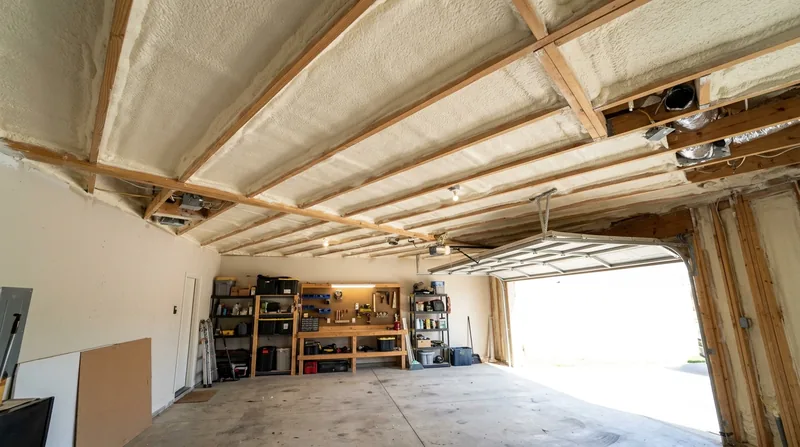




A garage in Houston isn't just a place to park. When it sits under a bonus room, workshop or conditioned space, it becomes part of your home's thermal envelope, and an uninsulated or poorly insulated garage ceiling bleeds cold air in winter and lets radiant heat pour in from May through October. Garage spray foam insulation seals that gap, turning a storage oven into usable space and cutting the load on your air handler. In a region where attic temperatures hit 150 degrees and humidity runs 90 percent year-round, the difference between fiberglass and closed-cell foam on a garage ceiling is the difference between a room you can work in and one you abandon by noon.
Why Garage Spray Foam Insulation Matters in Houston's Two-Story Stock
Greater Houston's master-planned subdivisions in Katy, Cypress, The Woodlands, Pearland and Sugar Land are dominated by two-story homes with garages directly below bonus rooms, game rooms and master suites. When the garage is uninsulated or filled with fiberglass that has flattened over fifteen years, the ceiling becomes a thermal sieve. Heat radiates upward in summer, cold seeps down in winter, and the room above stays uncomfortable no matter what the thermostat reads. Spray foam stops that transfer cold, creating an air barrier and raising the effective R-value of the entire assembly.
- Sealed ceiling eliminates thermal bridging through joists and eliminates the convection loop that makes fiberglass fail.
- Closed-cell foam resists moisture and vapor drive, critical in Houston's 90-percent humidity environment where condensation forms on cold surfaces in summer.
- Foam adheres to the substrate and fills voids, blocking air leakage around electrical boxes, recessed lights and ductwork penetrations.
- A properly insulated garage ceiling allows the room above to cool and heat evenly, reducing the strain on your HVAC system.
The payoff is immediate: the bonus room becomes livable in summer without the window unit, and your main cooling system doesn't have to fight a losing battle against a radiant ceiling.
Key info: In neighborhoods like Meyerland, Braeswood and Spring Branch, older homes with 1950s-70s brick construction often have uninsulated garages shared with the house. Spray foam seals the wall cavities and ceiling in one pass, stopping air leakage that fiberglass alone cannot address. Get a free estimate from us at (346) 322-2588 to see what applies to your address.
For more context on how insulation performs across different applications, see our guide to closed-cell spray foam insulation, which is the standard for garage ceilings under conditioned space.
How We Insulate Garage Ceilings and Walls in Houston
Garage insulation begins with a site visit to understand the structure, what sits above the ceiling, whether the walls are shared with the house, and what moisture or air-sealing issues already exist. We assess the joist depth, any existing insulation, electrical and mechanical penetrations, and whether the garage is vented or attached to the home. From there, we recommend either closed-cell foam (for moisture control and maximum R-value in a thin layer) or open-cell foam (for sound dampening and cost efficiency if the space will remain unconditioned). The installation itself is straightforward: we spray to the specified thickness in passes, maintain the manufacturer's drum temperature and ratio, run mechanical ventilation during cure, and observe a 24 to 48-hour re-entry window before the space is occupied.
- We inspect the ceiling framing, identify all penetrations and plan the spray pattern to avoid bridging or thin spots.
- We set up containment and mechanical ventilation to manage off-gassing and ensure the foam cures properly.
- We spray in controlled passes, allowing each layer to tack before the next, so the foam bonds to the substrate and reaches the specified R-value and thickness.
- We verify the installation against the estimate specs and provide a written record of R-value, thickness and coverage area.
- We schedule a follow-up to confirm the cure is complete and the space is ready for use.
The entire process, from estimate to finish, is transparent and documented so you know exactly what you're getting.
Example: A 500-square-foot garage ceiling in Sugar Land under a bonus room typically takes one day to spray. We apply 3.5 inches of closed-cell foam (R-21 nominal), which blocks radiant heat and moisture. The homeowner waits 24 hours before moving furniture back into the bonus room. The garage stays accessible for tools and storage, but the thermal barrier is now in place.
If your garage walls are also a thermal boundary, we can spray those at the same time. Learn more about wall and injection foam insulation to see how we handle shared walls and retrofit scenarios.
Garage Spray Foam Insulation Methods
| Approach | Description | Best for |
|---|---|---|
| Closed-cell spray foam ceiling | Dense, rigid foam sprayed to 3 to 5 inches, R-6 per inch, creates an air and vapor barrier in one layer. | Garage ceilings under conditioned rooms, humid climates, moisture control priority. |
| Open-cell spray foam ceiling | Lighter, softer foam sprayed to 5 to 7 inches, R-3.5 per inch, provides air sealing and sound dampening without rigid vapor barrier. | Unconditioned garages, workshops, spaces where sound control matters and moisture is not the primary concern. |
| Closed-cell walls and band joist | Spray foam applied to interior walls shared with the house, rim joists and band joists to seal air leakage and provide thermal break. | Garages attached to the house, older homes with poor wall insulation, energy loss through shared walls. |
| Retrofit over existing insulation | Spray foam applied over old fiberglass or mineral wool to restore R-value and seal air gaps without full removal. | Garages with settled or compressed insulation, cost-effective top-up when existing material is sound but insufficient. |
Each method is chosen based on the garage's use, the climate zone, and whether the space is conditioned or unconditioned. We will walk you through the pros and cons of each during your free estimate.
Garage Spray Foam Insulation Cost in Houston: What to Expect
Garage spray foam insulation in Houston typically starts at $1,200 for a small, straightforward ceiling. The final cost depends on the size of the ceiling in square feet, the foam type (closed-cell or open-cell), the depth of the joists, the number of penetrations and obstructions, and whether you're also insulating walls or the band joist. A 500-square-foot garage ceiling under a bonus room with closed-cell foam usually runs $1,500 to $2,500. Larger garages, detached structures, or jobs that include wall insulation will be higher. The best way to know is to get a free estimate with R-value and thickness specs written down, so you can compare apples to apples.
We encourage you to get estimates from at least two other contractors. When you do, make sure each estimate includes the R-value per inch, the total thickness in inches, the square footage of coverage, and the foam type. Vague estimates with no thickness or R-value are a red flag. Visit our pricing page for more detail on what factors move the cost up or down.
What to Look for When Hiring a Spray Foam Insulation Contractor Near Houston
Choosing a spray foam contractor is a decision that affects your comfort, energy bills and home value for years. The trade has two kinds of bad actors: rig-and-run crews from out of state who spray a job in an afternoon and disappear when the smell lingers or the foam shrinks, and national franchises that hire local labor and leave you with no recourse if something goes wrong. A local, independent contractor with a local address, local insurance and a track record in your neighborhood is your safest bet. Here's what to verify before you sign.
- Ask for proof of full insurance coverage, including general liability and workers' compensation, and verify it is current.
- Request references from at least three recent jobs in your area, and contact them to ask about the installer's communication, cleanup and how the foam has held up.
- Get written estimates from at least two contractors, each with R-value, thickness and square footage spelled out, so you can compare the scope and price fairly.
- Confirm that the contractor will run mechanical ventilation during the spray and cure, and will observe a 24 to 48-hour re-entry window before you use the space.
- Ask whether the contractor will help you understand what permits or approvals your city requires, and whether they handle the paperwork or you do.
- Verify that any estimate includes a walkthrough, a photo record of the before state, and a written scope that names the foam type, application method and expected R-value.
A contractor who takes time to understand your space, answers your questions clearly, and documents the work in writing is one you can trust. If you have questions about what we do or how we work, call us at (346) 322-2588 or visit our contact page to request a free estimate.
For more on how to vet any insulation contractor, including the questions to ask about air sealing and moisture control, see our air sealing guide.
Garage Spray Foam Insulation in Houston: Pricing Guide
| Service | Price | Details |
|---|---|---|
| Small garage ceiling (under 300 sq ft) | Starting at $1,200 | Closed-cell foam, 3 to 4 inches, R-value 18 to 24, includes mechanical ventilation and 24-hour cure window |
| Standard garage ceiling (300 to 600 sq ft) | Starting at $1,800 | Closed-cell or open-cell foam, depth and penetrations assessed on site, larger area reduces per-square-foot cost |
| Garage ceiling plus walls or band joist | Starting at $2,400 | Closed-cell foam applied to ceiling and shared walls, rim joist or band joist, air sealing included in one job |
| Retrofit over existing insulation | Starting at $1,500 | Spray foam applied over settled fiberglass or mineral wool, cost depends on existing material condition and thickness needed |
| Travel and estimate | Included and free | No mileage charge in Houston and surrounding areas, free written estimate with R-value and thickness within 24 hours |
Indicative pricing, the exact cost depends on square footage, finish, and site access. Free personalized estimate within 24h at (346) 322-2588.


