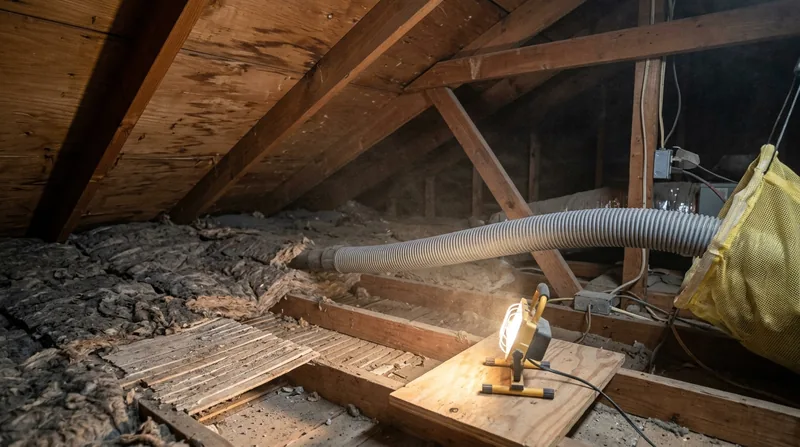




Houston's sprawling ring of slab-on-grade neighborhoods and master-planned subdivisions depend almost entirely on vented attics to house ductwork and insulation, and that insulation ages. Blown-in batts flatten into dense mats after fifteen to twenty years, failed spray foam hardens into foam chunks that crack and separate, and old fiberglass becomes a moisture trap in a climate where summer humidity climbs past 90 percent and vapor drive runs from the outside in. Insulation removal in Houston is not optional when you are upgrading to foam or when existing insulation has failed; it is the precondition of every retrofit. We vacuum out old material before any new foam goes in, and we cut out failed spray foam that other installers will not touch. The work is dirty, methodical, and non-negotiable if you want the new system to perform.
Why Insulation Removal Matters in a Houston Climate
Houston's attics bake at 130 to 150 degrees Fahrenheit from May through October, and that heat drives the region's brutal cooling bills. Old insulation loses its R-value as it settles and compacts, and when moisture gets into the mix, which it does in this humidity, fiberglass and cellulose become a thermal liability instead of an asset. Spray foam that was installed without proper ventilation during cure can absorb moisture and lose bond, leaving gaps and voids that bleed conditioned air into the unconditioned space. Removing the old material is the only way to see what you are actually working with, to verify that the substrate is sound and dry, and to ensure that new foam adheres properly and stays in place.
- We extract all old blown-in insulation, batts, and loose fill using commercial vacuum equipment to prevent dust and debris from settling into living areas.
- We identify and cut out failed spray foam, a job most installers skip because it requires careful demolition and hauling.
- We flag vermiculite insulation for professional testing before any disturbance, because it may contain asbestos.
- We inspect the substrate, framing, and roof decking for moisture, rot, or structural damage that must be addressed before foam goes down.
- We haul away all removed material responsibly, leaving the attic clean and ready for new insulation.
The result is a clean slate and a verifiable foundation for whatever retrofit or new installation comes next.
Key info: In neighborhoods like Meyerland, Braeswood, and Spring Branch, where 1950s and 1970s brick ranches still carry original fiberglass from the factory, the insulation has often flattened to half its original thickness. Removal and replacement with closed-cell foam is the only path to reclaim R-value and stop the air leaks that have widened over decades. See the Texas Building and Energy Code at the Texas Department of Licensing and Regulation for the energy code that governs attic insulation in your jurisdiction.
How We Remove Old Insulation and Prepare for Spray Foam
Removal is a sequence. We set up mechanical ventilation and containment to keep airborne dust out of the house, then vacuum out all loose fill and batts using commercial equipment rated for the job. If there is failed spray foam, we cut it out in sections, taking care not to damage the roof deck or framing. We inspect every inch of the substrate for moisture, stains, or soft spots that signal a leak or condensation problem. If we find moisture, we stop and walk away until the source is fixed. Only then do we proceed to attic spray foam insulation or whatever new system you have chosen.
- We set up negative air pressure and HEPA filtration to contain dust during removal.
- We vacuum out all old blown-in insulation, batts, and cellulose using industrial-grade equipment.
- We cut out and remove any failed spray foam, taking care to preserve the roof deck and framing.
- We inspect the substrate, framing, and any existing blocking or ventilation channels for damage or moisture.
- We flag and leave untouched any vermiculite insulation pending professional testing.
- We haul away all removed material and leave the attic clean, dry, and ready for new insulation.
This methodical approach ensures that the new foam system you choose will perform as designed.
Local example: A two-story home in Cypress with a bonus room over the garage typically carries 16 to 20 inches of settled fiberglass in the attic plus failed spray foam around the bonus room perimeter. We remove all of it, inspect the roof deck for moisture and soft spots, and prepare for a sealed attic retrofit with closed-cell foam. The whole job takes one to two days depending on attic size and access.
Removal Methods and Equipment
| Method | Description | Best For |
|---|---|---|
| Commercial Vacuum Removal | Industrial-grade vacuum with HEPA filtration and hose runs to contain dust and debris during extraction. | All blown-in and batt insulation; standard attic cleanouts across Houston. |
| Spray Foam Demolition | Careful hand-cutting and removal of hardened spray foam using reciprocating saws and chisels to preserve the roof deck and framing. | Failed or poorly installed spray foam; foam that has absorbed moisture or lost bond. |
| Substrate Inspection | Visual and tactile assessment of roof deck, framing, and sheathing for moisture stains, soft spots, or rot before any new system is installed. | Every job; non-negotiable for moisture-prone climates like Houston. |
| Vermiculite Flagging | Identification and marking of vermiculite insulation without disturbance, flagged for professional asbestos testing by a licensed lab. | Older homes in Houston, The Heights, and Montrose where vermiculite was common in mid-century construction. |
Insulation Removal Cost in Houston: What to Expect
Removal costs in Houston start at $950 for a small attic and scale upward based on the volume of insulation, the presence of failed spray foam, attic access, and the condition of the substrate. A typical single-story home with 1,200 to 1,500 square feet of attic space and settled fiberglass runs between $1,200 and $1,800. A two-story home in Katy or Sugar Land with a bonus room, higher ceilings, and failed spray foam around the perimeter can run $2,000 to $3,500. Homes with crawl spaces or multiple zones cost more. The biggest variable is whether failed spray foam is present and how much of it there is; cutting it out takes time and care.
Get two or three estimates from different contractors so you can compare scope, equipment, and timeline. A written estimate should specify the square footage of attic being cleared, the depth and type of insulation being removed, whether failed foam is present, and what the price includes for substrate inspection and hauling. Travel is included for work across Houston and the surrounding areas; there is no separate mileage charge. A free estimate takes about thirty minutes and comes with no obligation to book. Call us at (346) 322-2588 or visit our pricing page for more details.
Insulation Removal Near Me: What to Look for When Hiring a Contractor
Hiring the right contractor for insulation removal is about verification and clarity. Start by confirming that the contractor is fully insured with coverage that names spray foam work and demolition; ask for a certificate of insurance and verify the coverage is current. Get multiple written estimates that break down the scope, square footage, equipment used, and timeline. Check references from recent jobs in your neighborhood or a similar home type. Ask whether the contractor has dealt with failed spray foam before, because not all of them have. Understand whether any permits are required at your address; permitting rules vary across Houston, Katy, The Woodlands, and other cities in the service area, so ask your local building department what applies to you.
- Verify that the contractor carries full insurance for spray foam work and insulation demolition, and request a current certificate.
- Get written estimates from at least two contractors that specify attic square footage, insulation type, failed foam assessment, and total cost.
- Ask for references from homes in your neighborhood or with similar construction to yours.
- Confirm that the contractor has experience cutting out failed spray foam, because many do not.
- Check with your local building department to understand whether permits or notifications apply to your address.
- Avoid any estimate that has no R-value or thickness specification, no timeline, or a price far below market; these are red flags for corner-cutting.
The goal is to hire a contractor who will do the job right the first time and be reachable if questions come up during or after the work. Contact us for a free estimate and a conversation about what removal looks like for your home.
Insulation Removal in Houston: Pricing Guide
| Service | Price | Details |
|---|---|---|
| Small attic removal (single-story, 1,200-1,500 sq ft) | Starting at $950 | Blown-in insulation vacuum extraction, substrate inspection, and hauling included in this range for compact attics. |
| Standard attic removal (two-story, 2,000-2,500 sq ft) | Starting at $1,400 | Larger attic footprint, multiple access points, and standard fiberglass removal with full substrate inspection and cleanup. |
| Failed spray foam removal (any size) | Starting at $1,800 | Hand-cutting and demolition of hardened foam, careful preservation of roof deck, and safe hauling of foam debris. |
| Complex or multi-zone job | On estimate | Crawl spaces, bonus rooms, multiple attic levels, or extensive moisture damage require on-site assessment before pricing. |
| Travel and service calls | Included | No separate mileage fee or travel charge for work across Houston and surrounding areas within service radius. |
| Free estimate | No charge | Response within 24 hours at (346) 322-2588; thirty-minute site visit with written scope and pricing breakdown. |
Indicative pricing, the exact cost depends on square footage, finish, and site access. Free personalized estimate within 24h at (346) 322-2588.


