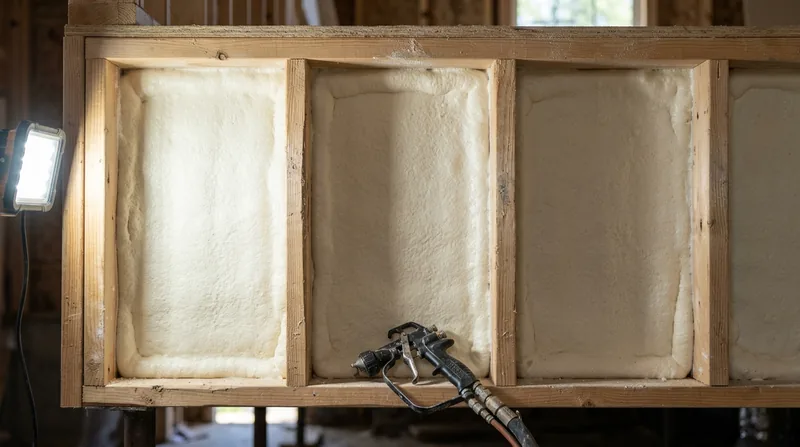




Band joists, cantilevers and bonus-room floors leak conditioned air at every framing gap, and in Houston's brutal summer humidity, that air loss hits your cooling bill hard. Rim joist and band joist spray foam seals those framing voids with a closed-cell pass, stopping the leak for good. It is one of the smallest jobs we do, but it carries one of the fastest paybacks in the house. In a region where two-story stock with bonus rooms over garages dominates the newer subdivisions (Katy, Cypress, Pearland, The Woodlands, Sugar Land), and where pre-war pier-and-beam homes in the Heights, Montrose and the East End sit on raised foundations with exposed band joists taking the full brunt of summer heat and humidity, this is the entry-ticket job with real, measurable comfort gain. No permits, no thermal-barrier confusion, no weeks of cure time. Just sealed framing, controlled humidity, and a smaller cooling load.
Why Band Joist and Rim Joist Sealing Matters in Houston's Climate
Houston sits on flat Gulf Coast prairie where nearly every home carries its ductwork through a vented attic that bakes at 130 to 150 degrees Fahrenheit from May through October. But the air leaks that drain your cooling dollars start lower. Band joists and rim joists are the horizontal framing members that sit at the top of your foundation walls and rim the perimeter of your floor system. They are riddled with gaps where the rim board meets the foundation, where rim board meets header joist, where insulation has compressed or never existed, and where mechanical penetrations and rim-block connections create a maze of small voids. Humid outside air infiltrates through those gaps, cools your conditioned air as it passes through the band joist cavity, and forces your air conditioner to work harder. The result is higher cooling bills and moisture accumulation in a space you cannot see.
- Band joists and rim joists connect your foundation to your floor framing and are exposed to outside temperature and humidity on the exterior side.
- Air leakage through framing gaps and compression voids in the rim joist can account for 10 to 15 percent of your home's total air loss.
- Closed-cell spray foam seals every gap and void in a single pass, creating an air barrier and a vapor barrier at the same time.
- Unlike fiberglass batts or blown-in cellulose, foam does not compress, does not settle, and does not allow air to bypass it.
- The job is fast, small-ticket, and requires no permits in most Houston neighborhoods because the work is interior and does not touch the building envelope above the rim.
Sealing your rim joist is the fastest way to cut infiltration in the lowest part of your house and keep humidity out of your floor system.
Key info: In Meyerland, Braeswood and Spring Branch, where 1950s to 1970s brick ranches sit on slab-on-grade with cantilever bonus rooms, the rim joist under the overhang is exposed to direct sun and full humidity. A closed-cell pass stops the air leak and the condensation that builds up inside the rim cavity during Houston's long, wet summers.
How We Seal Your Rim Joist: Step by Step in Houston
Rim joist sealing is straightforward work, but it demands attention to detail and the right equipment. We start with a site inspection to identify the rim joist perimeter, assess insulation condition, and locate any moisture or mold that needs attention before we spray. If the substrate is wet, contaminated or compromised, we walk away and refer you to the right trade. Once the space is dry and ready, we move in with our spray rig, set up mechanical ventilation, and apply closed-cell foam to the specified thickness (typically 1.5 to 2 inches for an R-value of 9 to 12 per inch). We control our spray passes, monitor drum temperature and ratio, and maintain ventilation throughout the cure window. You stay out of the space for 24 to 48 hours, and then the rim joist is sealed for life. For more details on closed-cell spray foam insulation and how it differs from open-cell, see our closed-cell page.
- We inspect the rim joist cavity and the foundation top for moisture, mold, or active leaks before any foam is applied.
- We set up mechanical ventilation and ensure air flow during the entire cure period to manage off-gassing safely.
- We apply closed-cell foam at the manufacturer's specified ratio and drum temperature, controlling pass thickness to achieve the designed R-value.
- We trim excess foam and leave the space unsealed for your re-entry window of 24 to 48 hours.
- You receive a written estimate with R-value and thickness specifications before we start.
The result is a sealed, insulated rim joist that stops air leakage and moisture infiltration for the life of the house.
Local example: A 1970s brick ranch in Spring Branch with a 40-foot rim joist perimeter and exposed crawl space typically needs 60 to 80 board feet of closed-cell foam, taking one afternoon and costing from $650 to $950. A newer two-story in Cypress with a 60-foot perimeter and bonus-room cantilever runs 90 to 120 board feet and costs from $950 to $1,400. Every job is measured on site.
Rim Joist Sealing Methods and Approaches
| Approach | Description | Best for |
|---|---|---|
| Closed-Cell Spray Foam | High-density polyurethane foam applied at 1.5 to 2 inches, cured in 24 to 48 hours, provides R-value of 9 to 12 per inch and acts as both air and vapor barrier. | Rim joists with moisture risk, humidity exposure, or where vapor drive is a concern (Houston's summer humidity, crawl spaces, vented foundations). |
| Caulk and Weatherstripping | Polyurethane caulk applied to gaps and seams, sometimes combined with foam backer rod for larger voids, does not provide insulation value. | Small, isolated gaps in rim joists where insulation is not the goal and air sealing alone is sufficient. |
| Fiberglass Batts or Blown Cellulose | Traditional insulation installed in rim joist cavities, compresses over time, does not seal air gaps, requires separate air barrier. | Budget-conscious work where the rim joist is not a primary air-leakage path and moisture risk is low. |
| Open-Cell Spray Foam | Lower-density foam applied at 3 to 4 inches for equivalent R-value, breathable, slower cure, lower cost per board foot. | Rim joists in dry locations where vapor permeability is acceptable and budget is a priority over vapor control. |
Closed-cell foam is the standard for rim joists in Houston because the region's humidity and temperature swing demand a vapor barrier and a durable, non-settling insulation. Caulk works for small gaps. Fiberglass compresses and does not seal. Open-cell is cheaper but does not provide vapor control and is not recommended for rim joists in humid climates. We recommend closed-cell for nearly every rim joist job in this region.
Rim Joist and Band Joist Spray Foam Cost in Houston: What to Expect
Rim joist sealing is one of the most affordable spray foam jobs in the house. A typical rim joist seal in Houston starts at $650 and ranges from $650 to $1,500 depending on the perimeter length, the depth of the rim cavity, the presence of existing insulation or debris, and whether the space is accessible without removing obstacles. A 40-foot perimeter in a single-story home or a crawl space typically runs 60 to 80 board feet. A two-story with a bonus room and a 60-foot perimeter runs 90 to 120 board feet. A larger footprint or a complex rim with multiple cantilevers can run 150 board feet or more. We measure on site and give you a written estimate with R-value and thickness before we start. Travel is included in Houston and surrounding areas. For a full pricing overview and to see how rim joist sealing compares to other spray foam work, visit our pricing page.
The best way to know what your rim joist job will cost is to get a free, no-obligation estimate. Call us at (346) 322-2588 and we will schedule a site visit within 24 hours.
Rim Joist and Band Joist Spray Foam Near Me: What Houston Homeowners Should Know When Hiring
Hiring the right spray foam contractor for your rim joist job is about verifying competence, insurance and transparency. The spray foam trade has two kinds of bad actors: rig-and-run crews from out of state who spray a job in an afternoon and are unreachable when the smell lingers, and national franchises with high overhead and franchise fees that inflate pricing. A local independent insulation shop is positioned against both. When you call a contractor, ask for proof of current general liability and workers' compensation insurance, a written estimate with R-value and thickness specifications, and references from recent jobs in your neighborhood. Ask whether they will provide mechanical ventilation during cure and a stated re-entry window. If a contractor promises immediate re-entry, guarantees zero odor, or claims the foam is non-toxic and 100 percent safe, that is a red flag. The honest position is that correctly installed spray foam is low-VOC once cured, meets code, and requires a 24 to 48 hour re-entry window. Verify that your contractor understands local permitting if your job touches a protected tree or a historic structure (rare for rim joist work, but it happens). Ask about HOA requirements if you live in a master-planned community. Most rim joist work is interior and requires no permits, but it is smart to confirm. For more on what makes a trustworthy contractor, contact us for a free estimate or call (346) 322-2588.
- Verify current general liability and workers' compensation insurance with a certificate of insurance, not just a verbal claim.
- Request a written estimate that specifies R-value, foam thickness in inches, and total board feet before work begins.
- Ask whether the contractor will provide mechanical ventilation during cure and confirm a 24 to 48 hour re-entry window.
- Get references from at least two recent jobs in your area and call them to ask about smell, cure time, and follow-up service.
- Confirm that the contractor understands local permitting for your address, even though most rim joist work requires no permits.
- Ask about HOA architectural rules if you live in a master-planned community and any exterior work is involved.
A local, insured contractor who gives you a detailed estimate, answers your questions directly, and stands behind the work is the one to hire.
Why Rim Joist Sealing Fits Into Your Whole-Home Air Sealing Strategy
Rim joist sealing is a small job, but it is part of a larger picture. Air leakage happens at rim joists, but it also happens at attic bypasses, crawl space headers, ductwork penetrations, and wall cavities. In Houston's climate, where humidity is the constant enemy and cooling costs dominate the summer bill, a whole-home air sealing strategy that includes the rim joist, the attic, and the crawl space delivers the biggest comfort and efficiency gain. We can seal your rim joist today and your crawl space next month. Or we can look at your whole house and prioritize the leaks that cost you the most money. For more on air sealing and how it works with spray foam insulation, see our air sealing page. And if your attic insulation is old, flat or missing, sealed attic spray foam is the signature job that pays for itself in a few years. We have been in business since 2012 and we know Houston's building stock. Call us at (346) 322-2588 for a free estimate on your rim joist or any other spray foam work.
Rim Joist & Band Joist Spray Foam in Houston: Pricing Guide
| Service | Price | Details |
|---|---|---|
| Rim Joist Sealing, Small Perimeter (40-50 feet) | Starting at $650 | Closed-cell foam at 1.5 to 2 inches, 60 to 80 board feet, single-story or crawl space |
| Rim Joist Sealing, Medium Perimeter (50-70 feet) | Starting at $950 | Closed-cell foam at 1.5 to 2 inches, 80 to 120 board feet, two-story with bonus room or cantilever |
| Rim Joist Sealing, Large Perimeter (70+ feet) or Complex Geometry | On estimate | Perimeter exceeds 70 feet, multiple cantilevers, existing debris or moisture requires removal first |
| Travel and Logistics | Included | No separate mileage or travel fee in Houston and surrounding service areas |
| Free Estimate | No charge | Written estimate with R-value and thickness specifications, response within 24 hours at (346) 322-2588 |
Indicative pricing, the exact cost depends on square footage, finish, and site access. Free personalized estimate within 24h at (346) 322-2588.


