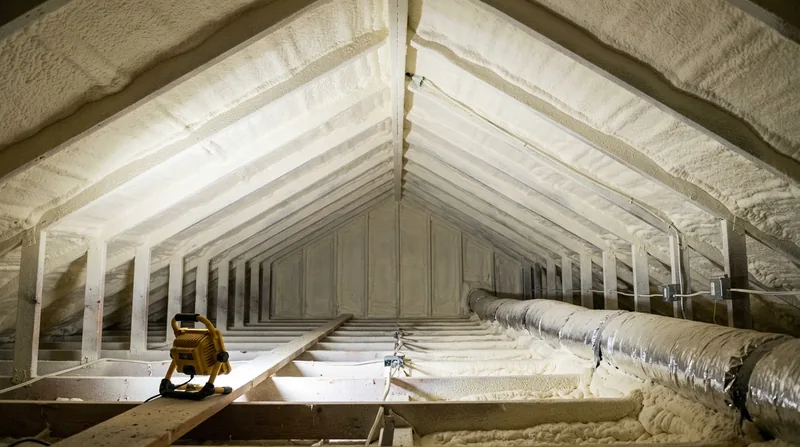




Houston's attic insulation problem is straightforward: your home sits on a slab in a ring of sprawling subdivisions, and your ductwork runs through an uninsulated attic that hits 140 to 150 degrees Fahrenheit from May through October. That temperature differential between your air-conditioned interior and the radiant heat above your ceiling is the single largest driver of cooling costs in the region. Attic spray foam insulation seals the ductwork inside the thermal envelope, stops the conditioned air from leaking into the attic, and turns a vented, hostile space into conditioned volume. From The Heights and Montrose to Katy, Cypress, and The Woodlands, Houston homeowners are replacing fiberglass batts and blown-in cellulose with spray foam because the math is unavoidable: a properly sealed attic with controlled R-value and mechanical ventilation during cure costs less to cool year-round than a vented attic with perfect ductwork. We've been installing attic spray foam across Greater Houston since 2012, and every estimate includes written R-value and thickness specifications so you know exactly what you're paying for.
Why Attic Spray Foam Insulation Matters in Houston's Climate
Houston's humidity and heat are relentless. From June through September, your attic is baking at temperatures that soften fiberglass and accelerate the degradation of blown-in insulation. The older your home, the more likely your original insulation has already settled, compacted, or been disturbed by HVAC work, leaving gaps and voids where conditioned air escapes directly into the attic. Vapor drive in Houston runs from outside to inside, meaning moisture is constantly pushing inward through your roof deck and walls. A sealed, foam-encapsulated attic stops that vapor intrusion, keeps your ductwork cool, and eliminates the convection currents that make vented attics so expensive to condition.
- Spray foam seals every gap, penetration, and duct joint so conditioned air stays inside the building envelope.
- Open-cell foam on the roof deck allows the attic to dry to the interior, preventing moisture traps and condensation on summer cool-downs.
- Closed-cell foam delivers higher R-value per inch, critical for tight attic spaces or when existing insulation must be removed and replaced.
- Written estimates specify R-value target and thickness per pass, so you're not guessing at what you've bought.
A properly sealed attic with foam insulation is the foundation of any serious cooling strategy in Houston, and it's the only retrofit that addresses both the conduction loss through the attic deck and the infiltration loss through ductwork and building seams at once.
Key info: Houston's building code requires a thermal barrier on spray foam in occupied attics, and a fifteen-minute thermal barrier (typically 1.5 inches of drywall or rated material) is the standard that separates compliant work from non-compliant work. Your local building department, not the insulation contractor, enforces this. Always verify what applies at your address.
For more on how foam seals and protects your home, see our page on air sealing in Houston.
How We Install Attic Spray Foam Insulation in Houston
The process is straightforward but detail-intensive. We start with a site survey to measure your attic, assess existing insulation, identify air leaks, and determine whether your attic deck is dry and ready for foam. If old insulation needs removal, we handle that first. We then set up mechanical ventilation, spray the foam to your specified R-value and thickness, and ensure the cure window is met before re-entry. Every job gets a written estimate with R-value, board footage, and cost before work begins.
- We inspect the attic for moisture, active leaks, or contamination that would prevent foam installation.
- Existing fiberglass, cellulose, or failed foam is removed and disposed of if replacement is your goal.
- We set up mechanical ventilation during spray and cure to control VOC off-gassing and meet code re-entry windows.
- Foam is sprayed to your target R-value and thickness, measured and documented on the estimate.
- We verify the thermal barrier requirement with your local building department and install or specify what's needed.
The job typically takes one to three days depending on attic size, removal scope, and whether thermal barrier installation is included. You'll receive a detailed walkthrough and a summary of what was installed, where, and at what R-value.
Example: A 1,500-square-foot attic in Pearland with settled fiberglass and exposed ductwork typically takes two days: day one for removal and setup, day two for foam spray and cure setup. Re-entry is allowed after 24 to 48 hours depending on temperature and humidity. The attic stays ventilated during cure to prevent condensation and off-gassing issues.
For more detail on closed-cell versus open-cell foam choices, see our guide to open-cell spray foam insulation in Houston.
Attic Spray Foam Insulation Methods and Approaches
| Approach | Description | Best for |
|---|---|---|
| Open-Cell Foam on Roof Deck | Low-density foam sprayed to the underside of the roof sheathing, sealing the attic as conditioned space and allowing vapor transmission to the interior. | Sealed attics with good roof ventilation, sound dampening, and lower initial cost per board foot. |
| Closed-Cell Foam on Roof Deck | High-density foam with superior moisture resistance, sprayed to the roof deck to create an air-tight, vapor-tight seal and structural reinforcement. | Attics with moisture risk, high humidity, or where maximum R-value per inch is needed in tight spaces. |
| Attic Floor Foam with Vented Soffit | Foam applied over the attic floor (joists and subfloor) while leaving soffit and ridge vents open, preserving a vented attic design. | Budget-conscious jobs where sealed attic is not the goal and existing roof ventilation is adequate. |
| Insulation Removal and Replacement | Complete removal of failed, settled, or contaminated insulation, followed by foam installation to new specifications. | Older homes with fiberglass batts or cellulose that have shifted, homes with prior water damage, and retrofit jobs where starting fresh is required. |
Each approach carries different R-value, moisture, and cost profiles. Your attic's existing condition, roof ventilation design, and cooling goals determine which method makes sense for your home.
Attic Spray Foam Insulation Cost in Houston: What to Expect
Attic spray foam insulation in Houston typically starts at $1.50 per square foot for open-cell foam on the roof deck, with closed-cell foam running higher due to material and labor intensity. The final cost depends on several concrete factors: the size of your attic, whether existing insulation must be removed, the target R-value, access difficulty, and whether thermal barrier installation is required by your local building department. A 1,200-square-foot attic with moderate removal needs and open-cell foam to R-30 typically runs $1,800 to $2,400. Closed-cell foam or deeper R-values push the cost up, as does removal of fiberglass, cellulose, or failed foam from a prior installation.
The best way to know your actual cost is to get written estimates from two or three contractors, each specifying R-value, board footage, thickness per pass, and whether removal is included. Estimates should be free and no-obligation, and they should arrive within 24 hours of your call. Avoid any estimate that omits R-value, thickness, or board footage, or that quotes only a per-square-foot price without specifying what that covers. A vague estimate is the hallmark of a rig-and-run crew that will spray fast, leave you with off-gassing or condensation issues, and disappear when the work doesn't perform as promised.
Cost factors: Removal of old insulation adds $0.25 to $0.50 per square foot. Tight attic access adds labor time. Higher R-values require thicker foam or multiple passes. Thermal barrier installation (drywall or rated material) is a separate line item. Travel within Houston and surrounding areas is included in our estimates.
For a detailed look at pricing across all our services, see our full pricing overview.
Attic Spray Foam Insulation Near Me: What Houston Homeowners Should Know When Hiring
Hiring the right spray foam contractor is as important as choosing the foam type itself. The insulation trade attracts both local, accountable shops and out-of-state rig-and-run crews that spray a job in an afternoon and vanish when the smell won't go away or condensation appears inside the attic. You need a contractor who is fully insured, provides written estimates with R-value and thickness, can explain the thermal barrier requirement for your specific address, and will walk you through the cure window and re-entry timeline. Ask for references from jobs completed in your neighborhood, and verify that any contractor you're considering can be reached after the work is done.
- Verify the contractor is fully insured and can provide a certificate of insurance before work starts.
- Request written estimates that specify R-value, board footage, thickness per pass, and whether removal is included.
- Ask whether the contractor will help you navigate permits and the thermal barrier requirement for your local building department.
- Confirm that mechanical ventilation will be used during spray and cure, and ask for the re-entry window in writing.
- Check references from jobs in your city or neighborhood, and ask how the contractor handled any post-installation questions.
A contractor who can answer these questions clearly and without hesitation is far more likely to deliver work that performs and lasts. If you're ready to get started, contact us for a free estimate at (346) 322-2588. We'll survey your attic, walk you through your options, and provide a written estimate within 24 hours, no obligation to book.
Attic Spray Foam Insulation in Houston: Pricing Guide
| Service | Price | Details |
|---|---|---|
| Open-Cell Foam Attic Insulation | Starting at $1.50/sq ft | Includes roof deck spray, mechanical ventilation during cure, and written R-value specification. Attic size and removal scope determine final cost. |
| Closed-Cell Foam Attic Insulation | Starting at $2.25/sq ft | Higher density, superior moisture resistance, and greater R-value per inch. Best for humid climates and tight attic spaces needing maximum performance. |
| Insulation Removal and Replacement | Starting at $0.75/sq ft removal, plus foam cost | Complete tearout of fiberglass, cellulose, or failed foam, disposal, and new foam installation. Removal scope and attic accessibility affect final estimate. |
| Complex or Large-Scale Attic Project | On estimate | Jobs exceeding 2,000 square feet, multiple attic zones, or structural complications require on-site measurement and detailed scope review before pricing. |
| Travel and Service Call | Included | No separate charge for travel within Houston and surrounding service areas. Estimate response within 24 hours at (346) 322-2588. |
| Free Estimate | Free | Written estimate with R-value, board footage, and thickness specifications. No obligation to book. Call (346) 322-2588 or request online. |
Indicative pricing, the exact cost depends on square footage, finish, and site access. Free personalized estimate within 24h at (346) 322-2588.


