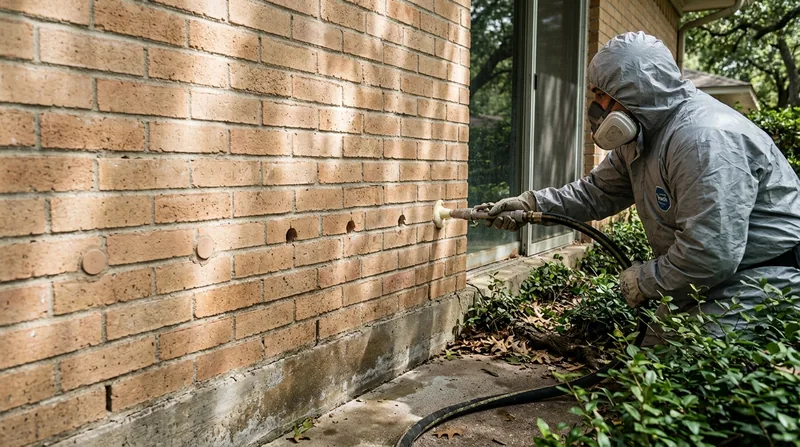




Wall & Injection Foam Insulation in Houston is the retrofit answer for the region's vast stock of 1950s through 1970s brick ranches and ranch-style homes with empty wall cavities and no insulation between the studs. Houston's flat Gulf Coast terrain and ring-after-ring suburban sprawl mean that tens of thousands of older homes sit with thin or missing wall insulation, while summer heat and humidity push cooling costs higher every year. Injection foam fills those empty cavities through small drilled ports, no demolition, no drywall removal, and no weeks of disruption. The method works because Houston's dominant failure mode is not vapor or condensation in the walls themselves, but rather the sheer thermal load bleeding through uninsulated exterior walls on the south and west faces, turning bedrooms and living spaces into heat sinks. If your home was built before 1980 and rooms on certain sides never seem to cool down, or your bills spike the moment the outdoor temperature hits 95 degrees, wall injection foam is often the missing piece. We have been serving Houston and the surrounding area since 2012, and we help homeowners understand whether injection foam is the right choice or whether a different approach makes more sense for their specific walls and budget.
Why Wall & Injection Foam Insulation Matters in Houston's Aging Housing Stock
Houston's 1950s-70s neighborhoods, from Meyerland and Braeswood to Spring Branch and the areas around Bellaire, are filled with single-story and split-level brick homes built with standard wood-frame construction and no wall insulation. The original design assumed moderate cooling loads and lower energy costs; today's reality is brutal summer heat radiating through those uninsulated exterior walls for five months straight. A typical older Houston home loses or gains more energy through its walls than through its attic, because the wall surface area is enormous and the thermal resistance is zero. Injection foam solves this without tearing into the drywall or the brick exterior.
- We drill small ports (typically 1 to 1.5 inches diameter) through the exterior brick or siding at regular intervals along the wall cavity.
- We inject closed-cell or open-cell foam into the cavity under controlled pressure, filling the space between the studs from bottom to top.
- The foam expands slightly, seals air gaps and thermal bridges, and bonds to the studs and rim board as it cures.
- Ports are plugged with foam or wooden dowels, sanded flush, and painted to match the exterior, leaving no visible trace.
- Interior drywall, insulation, or finishes remain untouched; the work is invisible from inside the home.
This approach is the only practical retrofit for homes where interior demolition is not an option, where the exterior is brick or stone, or where the homeowner wants to preserve the existing wall assembly and avoid the cost and mess of opening the walls.
Key info: A typical 2,000 square foot Houston home with 40 percent of its perimeter on the west and south faces can have 800 to 1,200 linear feet of exterior wall. Injecting those cavities takes one to two days and costs far less than adding exterior insulation or interior furring and batting.
For more detail on how foam insulation works in Houston's climate, see our page on Closed Cell Spray Foam Insulation, which covers the R-value and performance specs that make injection foam effective in our heat-driven environment.
How We Perform Wall & Injection Foam Insulation in Houston: Process and Technique
Injection foam installation begins with a thorough site inspection to identify the wall cavities, assess the exterior material (brick, wood siding, fiber cement, vinyl), locate utilities and obstacles, and confirm that the walls are dry and free of moisture or active leaks. We do not inject into wet walls, and if we find evidence of a roof leak, gutter failure, or foundation seepage affecting the wall, we tell you plainly and walk away until the moisture source is fixed. Once the wall is confirmed dry, we lay out the injection ports, drill them at intervals (typically 16 to 24 inches vertically and horizontally, depending on stud spacing), and prepare the equipment.
- We set up mechanical ventilation in the work area to manage off-gassing during the injection and cure phases.
- We rig the injection hose and nozzle to the spray foam equipment, confirm the material ratio and temperature per the manufacturer spec, and test the spray pattern on a scrap board.
- We inject the foam cavity by cavity, moving the nozzle slowly from the bottom port upward to fill the stud bay completely without voids.
- We allow the foam to cure fully (typically 24 to 48 hours depending on temperature and humidity) before we plug the ports and finish the exterior.
- We sand the plugged ports smooth, prime, and paint them to match the exterior wall finish.
The entire process is contained to the exterior; no drywall is opened, no interior insulation is disturbed, and no structural work is required. For a typical 1,500 square foot Houston ranch with three exterior walls needing injection, the work takes two to three days from start to finish.
Example: A Meyerland home built in 1965 with 16-inch stud spacing and brick exterior had empty wall cavities on the south and west faces. We drilled ports at 24-inch intervals, injected approximately 2,400 board feet of closed-cell foam into the cavities, and completed the work in two days. The homeowner reported a 12-degree drop in the temperature of the bedroom on the southwest corner within the first week of the following summer.
If you are also looking to improve your attic or crawl space, see our pages on Attic Spray Foam Insulation and Crawl Space Spray Foam Insulation, which are often paired with wall injection to maximize energy performance.
Wall & Injection Foam Insulation Methods: Comparing Closed Cell and Open Cell
| Foam Type | R-Value per Inch | Best for Houston Walls | Cost Range |
|---|---|---|---|
| Closed Cell | 6.0 to 7.0 | Exterior walls on south and west faces, maximum thermal resistance in minimal thickness, vapor barrier properties prevent moisture intrusion. | $2.50 to $4.00 per board foot |
| Open Cell | 3.5 to 4.0 | Interior walls or non-critical cavities where R-value per inch is less important and cost is the primary driver, interior sound dampening applications. | $1.00 to $1.50 per board foot |
| Injection (Mixed Application) | Closed cell 6.0 to 7.0; open cell 3.5 to 4.0 | Retrofit of existing cavities without demolition, ideal for Houston's 1950s-70s stock, seals thermal bridges and air leaks in one pass. | $2.00 to $3.50 per square foot of wall |
| Full Wall Cavity Fill | Closed cell throughout | Homes with all-foam strategy, maximum performance on all exterior walls, vapor control in high-humidity climates like Houston. | $2.00 to $3.00 per square foot of wall |
Closed cell is the standard choice for Houston wall injection because it delivers the highest R-value in the available cavity depth (typically 3.5 to 5.5 inches between studs), and its vapor-retarding properties protect against the humidity and condensation risk that is endemic to our climate. Open cell is chosen only when cost is the primary constraint and the wall is not on an exterior face where summer heat gain is the dominant failure mode.
Wall & Injection Foam Insulation Cost in Houston: What to Expect
Wall and injection foam insulation in Houston typically starts at $2.00 to $3.50 per square foot of wall surface, depending on the foam type (closed cell or open cell), the wall cavity depth, the number of ports required, and the exterior finish (brick costs more to drill and finish than wood siding or vinyl). A typical 1,500 square foot Houston ranch with 1,200 linear feet of exterior wall on three sides can expect a total cost in the range of $2,400 to $4,200 for closed cell injection on the south and west faces, and somewhat less if only open cell is used or if the scope is limited to a single wall or a few rooms.
The factors that most affect the final cost are the number of linear feet of wall to be injected, the foam type and R-value target, the exterior material and finish (brick versus siding), the condition and accessibility of the walls, and whether additional services like air sealing or rim joist foam are included in the same project. A home in Pasadena or Pearland with standard wood siding and accessible walls will cost less than a Meyerland home with thick brick and tight access to the west face. If your home has vinyl siding that must be carefully removed and reinstalled around the injection ports, or if the walls are in an HOA-controlled neighborhood where exterior work requires approval, costs can increase.
We recommend getting two or three written estimates from different contractors, each specifying the R-value, the foam type, the total board feet or square footage, the thickness of the foam, and the warranty on the installation. Avoid any estimate that does not include these details, or that quotes a price per square foot without naming the foam type or R-value. The cheapest estimate is often a sign of corners cut, inadequate ventilation during cure, or a contractor who is not insured or who will not be reachable if problems arise after the work is done.
For a detailed breakdown of pricing across all our services and service areas, visit our pricing page or call us at (346) 322-2588 for a free estimate with no obligation.
What to Look for When Hiring a Wall & Injection Foam Insulation Contractor Near Me in Houston
Hiring the right spray foam contractor for wall injection is critical because the work is performed on the exterior of your home, requires drilling into your walls, and involves handling pressurized equipment and chemical materials. The difference between a professional installation and a careless one is not always visible on the day the work is done, but it shows up within weeks when the cure smell lingers, the foam does not reach the top of the cavity, or the exterior finish cracks and fails. Here are the key things to verify before you sign a contract.
- Confirm that the contractor carries full insurance (general liability and workers compensation) and can provide a current certificate of insurance naming you as an additional insured.
- Ask for at least three references from homes in Houston where wall injection foam was completed in the past two years, and call those homeowners to ask about the smell, the cure time, the finish quality, and whether they would hire the same contractor again.
- Request a written estimate that includes the foam type, the R-value per inch, the total thickness of foam in the cavity, the number of board feet, the square footage of wall, the price per square foot or per board foot, and a one to three year warranty on the installation workmanship.
- Verify that the contractor will perform a moisture inspection before any foam is sprayed, and ask what happens if the walls are found to be wet or if a leak is discovered during the work.
- Ask about the ventilation plan during the cure period and the re-entry window (typically 24 to 48 hours for closed cell foam), and confirm that the contractor will not promise immediate occupancy or re-entry before the foam has fully cured.
- If your home is in an HOA or a historic district, ask the contractor whether they have experience navigating architectural review and permitting for exterior work, and whether they will help you obtain any necessary approvals before work begins.
A professional contractor will welcome these questions and will provide detailed, honest answers. If a contractor avoids specifics, quotes a price far below the market range, promises immediate results or a lifetime warranty, or cannot provide references or proof of insurance, move on to the next contractor. For more information on what to expect from a free estimate, contact us at (346) 322-2588 and we will walk you through the process and answer any questions about your specific walls and home.
Wall & Injection Foam Insulation in Houston: Pricing Guide
| Service | Price | Details |
|---|---|---|
| Closed Cell Wall Injection (per square foot) | Starting at $2.50/sq ft | Exterior walls on south and west faces, maximum thermal resistance, vapor barrier properties, typical Houston ranch application |
| Open Cell Wall Injection (per square foot) | Starting at $1.50/sq ft | Interior walls or cost-sensitive retrofits, lower R-value per inch, suitable for non-critical cavities or mixed foam strategy |
| Full Exterior Wall Coverage (typical 1,500 sq ft home) | Starting at $2,400 | Closed cell injection on south and west faces, 1,200 linear feet of wall, includes drilling, foam, curing, port finishing and painting |
| Partial Wall or Single Face (e.g., bonus room retrofit) | On estimate | Scope varies by room size, exterior material, accessibility, and foam type, requires on-site inspection to quote accurately |
| Travel and mobilization | Included | No separate charge for travel within Houston and surrounding service areas, included in the per-square-foot or project estimate |
| Free estimate with written specifications | Free | Response within 24 hours at (346) 322-2588, includes R-value, thickness, foam type, and board-foot calculation, no obligation to book |
Indicative pricing, the exact cost depends on square footage, finish, and site access. Free personalized estimate within 24h at (346) 322-2588.


