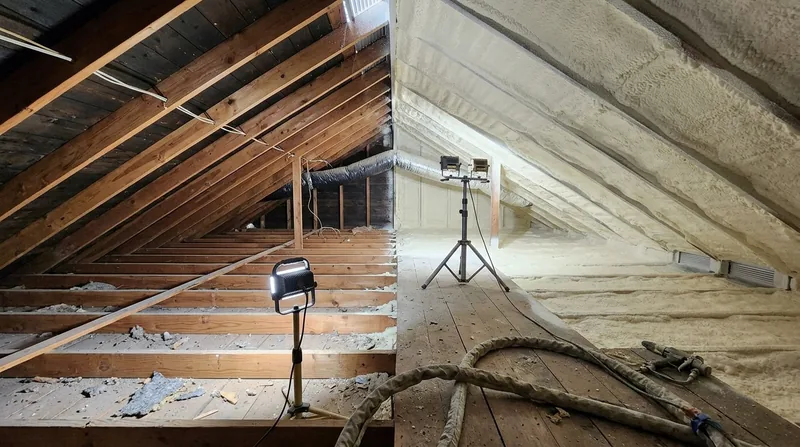




Houston's flat Gulf Coast sprawl runs almost entirely on slab-on-grade construction with vented attics that bake at 130-150°F from May through October. Inside those attics sits insulation installed in 1995, 2005, or even 2015 that has flattened, settled, or absorbed moisture from the region's relentless 90%+ summer humidity. Insulation Replacement & Re-Insulation in Houston is the full reset: we remove the failed material, air-seal the gaps that have opened over time, and install new foam to current code R-values. This is the job that brings cooling bills back down and stops the constant battle against heat and moisture that defines Houston's climate. Whether your home sits in The Heights, Meyerland, Katy, or out toward Conroe, the same physics applies: old insulation fails, and the sooner you replace it, the sooner your air conditioner stops fighting a losing battle.
Why Insulation Replacement & Re-Insulation Matters in Houston's Heat and Humidity
Houston's attic insulation has a working life. Fiberglass batts and blown-in cellulose compact under their own weight and absorb moisture from the humid air that leaks in around unsealed penetrations. After fifteen to twenty years, an R-38 attic becomes an R-22 attic. The cooling load climbs, energy costs climb, and the interior stays hotter longer. Humidity that should condense on the outside of the insulation instead soaks into it, especially in pier-and-beam homes in the Inner Loop and East End where crawl space moisture rises directly into the subfloor and attic. The fix is not another layer of blown-in material over the failed base, which is a temporary patch. The fix is removal, air sealing, and new insulation installed to code.
- We remove all failed or settled insulation and haul it off site, leaving a clean substrate to work from.
- We seal air leaks around electrical boxes, ductwork, and rim joists that allow hot air and moisture to bypass the insulation.
- We install closed-cell or open-cell spray foam to the R-value and thickness required by the current energy code at your address.
- We verify the job with thickness measurements and written estimates that state R-value and board-foot coverage.
The result is an attic that actually insulates and a home that stays cooler with less cycling of the air conditioner.
Key info: A 1,500-square-foot Houston attic with settled R-19 fiberglass typically needs 4 to 6 inches of closed-cell foam to reach R-38 to R-49 code minimum. Open-cell foam requires 7 to 10 inches for the same R-value but costs less and is the right choice when vapor drive and condensation are not the driver. We help you choose based on your attic's exposure and your cooling load.
For more on how foam seals and insulates at the same time, see our full overview of Attic Spray Foam Insulation or visit the City of Houston Planning Department for energy code requirements at your address.
How We Handle Insulation Replacement & Re-Insulation: Step by Step
Replacement work is surgical. We start with an inspection to measure the existing insulation, check for moisture or contamination, and identify all the air leaks that have developed. We then quote the full scope: removal cost, disposal, air sealing materials, and the new foam system. Once you approve, we schedule the work, pull any permits required by your city or HOA, remove the old material, and install new foam in a single mobilization. The job typically takes one to three days depending on attic size and complexity.
- We inspect the attic, measure existing insulation depth, and identify all air leaks and moisture issues.
- We provide a written estimate with R-value, thickness, and board-foot coverage for the new foam system.
- We remove all old insulation and dispose of it off site; we do not leave it in place and foam over it.
- We seal rim joists, band joists, electrical penetrations, and ductwork with closed-cell foam or caulk.
- We install new spray foam to the required R-value and thickness, with mechanical ventilation during cure.
- We provide a re-entry window of 24 to 48 hours before the space is safe for normal use.
This methodical approach ensures the replacement job lasts and performs as designed.
Local example: A 1970s brick ranch in Braeswood with original R-19 attic insulation and no air sealing around the roof penetrations. We removed 3,200 square feet of settled fiberglass, sealed 47 linear feet of rim joist and 12 recessed light fixtures, and installed 5.5 inches of closed-cell foam for R-38. Total attic coverage: 2,400 board feet. Job time: two days. Cost: typical for a mid-size home retrofit. See our Insulation Removal page for details on the tearout phase.
Insulation Replacement Methods: Closed Cell vs. Open Cell
| Approach | Description | Best for |
|---|---|---|
| Closed-Cell Spray Foam Replacement | High-density foam (1.5 to 2 lb/cu ft) installed at 4.5 to 6 inches for R-38 to R-49. Stops moisture and vapor completely. Requires 15-minute thermal barrier or ignition barrier per code. | Humid attics, vented crawl spaces, homes with moisture issues, metal buildings. Houston's humidity makes this the most common choice. |
| Open-Cell Spray Foam Replacement | Low-density foam (0.5 lb/cu ft) installed at 7 to 10 inches for R-38 to R-49. Allows vapor to pass through. Lower cost per square foot. Requires ignition barrier. | Attics with low external moisture risk, sound dampening, budget-conscious replacements. Best when the attic is already well-sealed and moisture is not the driver. |
| Blown-In Insulation Top-Up | Cellulose or fiberglass blown over an existing sound attic base to add depth. Does not air seal. Cost-effective but temporary and not a replacement. | Adding R-value to an already-sealed attic with no air leaks. Not recommended for Houston homes with humidity and air leak issues. |
| Foam Plus Blown-In Hybrid | Spray foam applied to seal all penetrations and rim joists, then blown-in cellulose or fiberglass layered on top for added R-value at lower cost. | Large attics where R-value is the goal and air sealing is the priority. Reduces foam volume and total cost while maintaining moisture control. |
The choice between closed-cell and open-cell depends on your attic's exposure to external moisture, the existing air sealing, and your budget. In Houston's humid climate, we often recommend closed-cell spray foam for the moisture control it provides, but the right answer is always specific to your home. We lay out both options in the estimate and let you decide.
Insulation Replacement & Re-Insulation Cost in Houston: What to Expect
Replacement work starts at $2,800 for a small attic (under 800 square feet) with straightforward access and no contamination. A typical 1,500-square-foot attic with removal, air sealing, and closed-cell foam installation runs $6,500 to $9,500. Larger homes and complex jobs with difficult access, multiple penetrations, or structural repairs can run higher. The main factors that move cost are attic square footage, foam type (closed-cell is denser and costs more per board foot than open-cell), the amount of air sealing required, and disposal of the old insulation.
We recommend getting two or three estimates from local contractors so you can compare scope, R-value, and warranty. Make sure each estimate includes the thickness of foam to be applied, the board-foot total, and the removal and disposal cost. A vague estimate with no R-value or thickness is a red flag, as is a price far below market with no inspection. We provide a written estimate at no cost within 24 hours. Call (346) 322-2588 or visit our pricing page for a detailed breakdown of what drives cost in your area.
Many homeowners qualify for federal energy efficiency tax credits when they replace insulation to meet current code R-values. We help you understand what applies to your project.
What to Look for When Hiring an Insulation Contractor Near Me in Houston
The spray foam insulation market in Houston includes local independent shops, national franchises, and rig-and-run crews from out of state. A good contractor is fully insured, provides written estimates with R-value and thickness, and has verifiable references. Verify that your contractor is registered with the city or county where the work will happen (registration requirements vary by city and there is no reciprocity across Greater Houston). Ask about permits: attic ventilation and thermal barrier rules are governed by the energy code at your address and the building official, not the contractor. Some HOAs in master-planned areas govern exterior work on metal buildings or additions, so check your deed restrictions before hiring. Always ask for mechanical ventilation during cure and a stated re-entry window of 24 to 48 hours, which is the mark of a professional installation.
- Verify the contractor is fully insured and ask to see the certificate of insurance naming your address.
- Get a written estimate with R-value, thickness in inches, and total board feet of foam to be installed.
- Check references from recent jobs in your neighborhood or similar home type.
- Ask whether the contractor pulls permits and helps you navigate what the building department requires at your address.
- Confirm mechanical ventilation during cure and a 24 to 48-hour re-entry window before normal use.
- Understand the workmanship warranty (typically one to three years) and any manufacturer system warranty on the foam itself.
A contractor who walks away from a wet or contaminated attic rather than spray over it is showing you the right judgment. Moisture must be fixed first, or the foam job will fail. Contact us for a free estimate and to discuss your specific situation.
Insulation Replacement & Re-Insulation in Houston: Pricing Guide
| Service | Price | Details |
|---|---|---|
| Small attic replacement (under 800 sq ft) | Starting at $2,800 | Removal, air sealing, and open-cell or closed-cell foam to R-38. Straightforward access, minimal penetrations. |
| Typical mid-size home (1,200-1,600 sq ft attic) | Starting at $5,500 | Full removal, rim joist sealing, closed-cell foam for moisture control in Houston's humid climate. Most common job. |
| Large attic or complex retrofit (1,800+ sq ft, multiple penetrations) | Starting at $8,500 | Extensive air sealing, difficult access, structural work, or hybrid foam plus blown-in approach. On-site estimate required. |
| Crawl space or basement rim joist replacement | Starting at $1,200 | Closed-cell foam on rim joist, band joist, and rim board to stop moisture and heat loss. Entry-level retrofit scope. |
| Travel and estimate | Included | No mileage fee or call-out charge within Houston service area. Free written estimate within 24 hours. |
Indicative pricing, the exact cost depends on square footage, finish, and site access. Free personalized estimate within 24h at (346) 322-2588.


