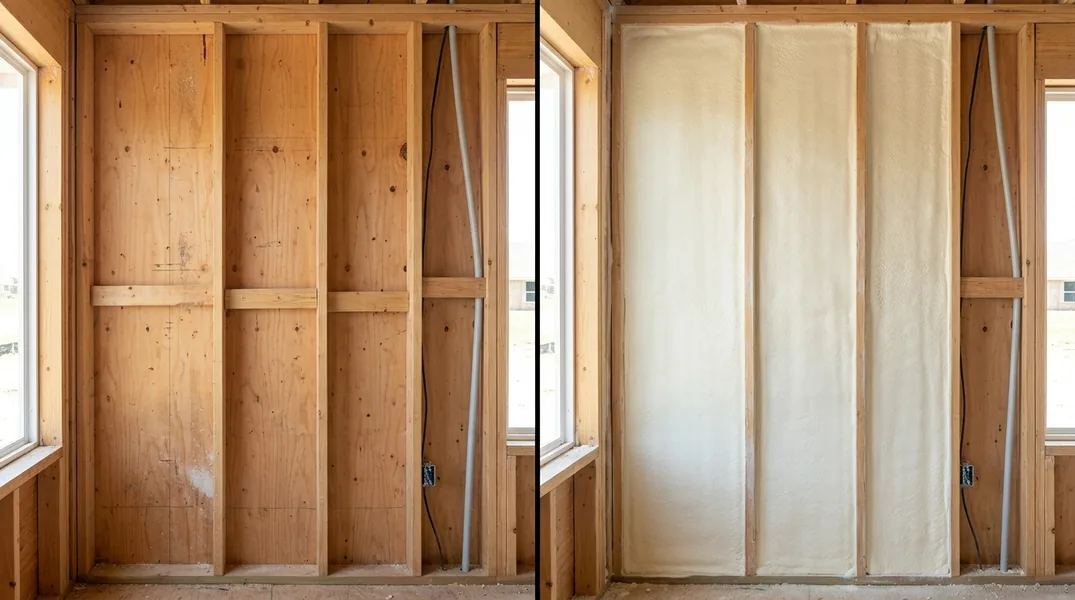
Understanding Spray Foam: Open-Cell vs Closed-Cell
When you're researching Attic Spray Foam Insulation for your Houston home, you'll quickly encounter two main options: open-cell and closed-cell spray foam. While both serve the same basic purpose of insulating and sealing your attic, they work in fundamentally different ways and offer distinct advantages depending on your situation.
The key difference comes down to the structure of the foam itself. Open-cell spray foam has cells that are not completely encapsulated, allowing air and moisture to pass through the material. Think of it like a sponge with interconnected pores. Closed-cell spray foam, by contrast, has cells that are completely sealed, creating a denser, more rigid barrier that resists moisture and air infiltration. Understanding this structural difference is essential for making an informed decision about which type suits your home best.
Open Cell Spray Foam: Flexibility and Affordability
Open Cell Spray Foam Insulation is lighter and more flexible than its closed-cell counterpart. Because the cells remain open, the foam expands more freely during installation, filling irregular spaces and gaps with ease. This flexibility makes it particularly useful for attics with complex framing, odd angles, or existing obstacles. Many homeowners appreciate how open-cell foam conforms to the unique geometry of their attic space without requiring additional cutting or fitting.
One of the primary advantages of open-cell foam is its lower cost compared to closed-cell options. If your budget is a concern and you're looking for solid insulation performance without breaking the bank, open-cell spray foam can deliver good results at a more accessible price point. The material also allows your attic to breathe, which can be beneficial in certain climates. However, because it's more permeable, open-cell foam does not provide the same moisture barrier as closed-cell products, and it typically has a lower R-value per inch of thickness, usually ranging from R-3.5 to R-3.8 per inch.
Closed Cell Spray Foam: Superior Performance and Protection
Closed Cell Spray Foam Insulation is the premium option for homeowners who prioritize maximum insulation performance and moisture protection. The sealed cell structure creates a vapor barrier, which is especially valuable in humid climates like Houston, where moisture control is critical to preventing mold, rot, and structural damage. This barrier helps keep moisture out of your attic, protecting your roof deck, rafters, and other wooden components from water damage and decay.
The closed cell spray foam R value is significantly higher than open-cell, typically ranging from R-6 to R-7 per inch of thickness. This means you need less material to achieve the same insulation value, which can be an advantage if you have limited attic space or clearance issues. Additionally, closed-cell foam is denser and more rigid, providing structural reinforcement to your roof assembly. While the upfront cost is higher, the superior performance and durability often justify the investment for homeowners seeking long-term protection and energy efficiency.
Spray Foam R-Value: What You Need to Know
Understanding spray foam R value is crucial when comparing your insulation options. R-value measures thermal resistance, or how effectively a material resists heat flow. The higher the R-value, the better the insulation performance. In Houston's hot, humid climate, adequate attic insulation is essential for keeping cooling costs down and maintaining consistent indoor temperatures during our long, scorching summers.
For attic insulation, most building codes recommend an R-value between R-38 and R-60, depending on your specific location and local requirements. With open-cell foam at roughly R-3.5 to R-3.8 per inch, you'd need 10 to 17 inches of material to reach R-38. With closed-cell foam at R-6 to R-7 per inch, you'd only need 6 to 10 inches. This difference in thickness can matter significantly in attics with height restrictions. Both types perform well when installed correctly, but closed-cell foam achieves higher R-values in a more compact footprint. The choice ultimately depends on your available space, budget, and performance goals.
Attic Spray Foam Insulation Cost in Houston: What to Budget
When evaluating pricing for spray foam insulation, expect to pay more for closed-cell than open-cell. Open-cell spray foam typically costs between $0.50 and $1.00 per board foot, while closed-cell spray foam ranges from $1.00 to $2.00 per board foot or more, depending on your specific attic size and complexity. The total cost for your project will depend on the square footage of your attic, the desired R-value, and local labor rates.
While closed-cell foam carries a higher upfront cost, many homeowners find the investment worthwhile when considering long-term energy savings, moisture protection, and durability. In Houston's humid climate, the added protection against moisture damage can prevent costly repairs down the road. To get an accurate estimate tailored to your home and needs, reach out to Houston Spray Foam Insulation at (346) 322-2588 for a free estimate. Our team can assess your attic, discuss your goals, and provide a detailed quote that helps you understand the value of your investment.
Which Type Is Right for Your Houston Home?
Choosing between open-cell and closed-cell spray foam depends on several factors unique to your situation. If budget is your primary concern and you have adequate attic space, open-cell foam offers solid insulation performance at a lower price. It's a practical choice for homeowners who want improved energy efficiency without a premium investment. However, if you're concerned about moisture control, want the highest possible R-value in a compact space, or are planning a long-term investment in your home's durability, closed-cell foam is the superior choice.
Houston's hot, humid climate naturally favors closed-cell foam's moisture-blocking properties. The region's frequent heavy rains and high humidity levels mean that attic moisture management is not just a nice-to-have feature but a critical defense against mold, wood rot, and structural deterioration. If your attic has any history of moisture issues, or if you're building or renovating with long-term performance in mind, closed-cell spray foam provides peace of mind that open-cell cannot match. Whatever you decide, professional installation is essential. Contact Houston Spray Foam Insulation today at (346) 322-2588 to discuss your options and get started on improving your home's insulation and energy efficiency.
Looking for a professional spray foam insulation contractor in Houston? Houston Spray Foam Insulation responds fast for all your spray foam insulation needs.
Get a Free Quote