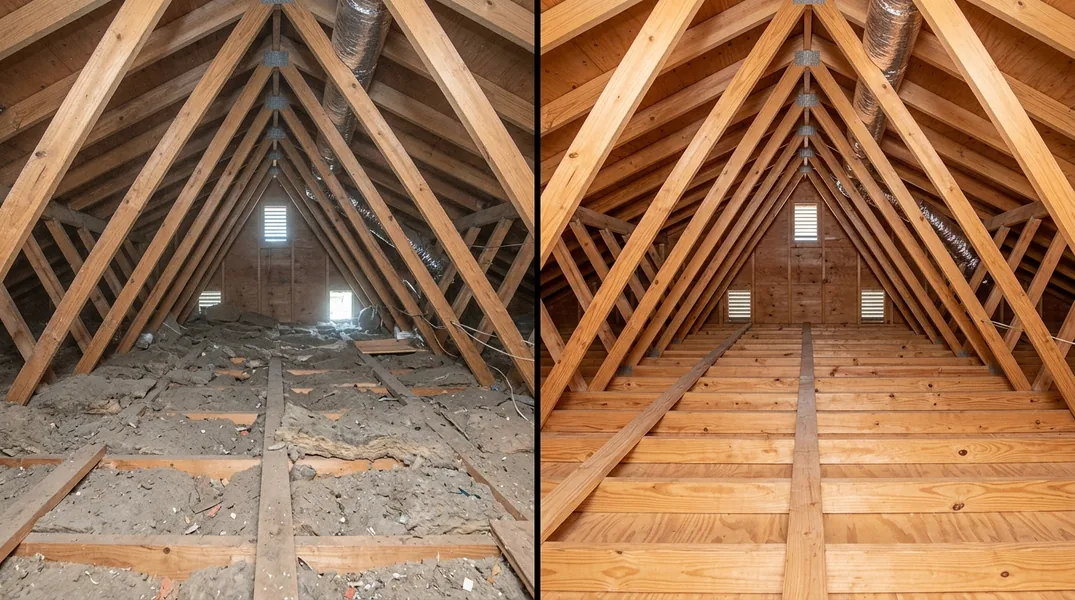
Understanding the Core Difference: Spray Foam vs Blown-In Insulation
When homeowners in Houston start researching attic insulation upgrades, they quickly encounter two dominant options: spray foam and blown-in insulation. While both serve the same fundamental purpose, they work in fundamentally different ways, and understanding those differences is the first step toward making an informed decision for your home.
Attic Spray Foam Insulation is applied as a liquid that expands and hardens, creating a continuous barrier that seals air leaks while providing insulation value. Blown-in insulation, by contrast, consists of loose fibers (typically cellulose, fiberglass, or mineral wool) that are pneumatically distributed across your attic floor. The spray foam approach offers superior air sealing and moisture resistance, while blown-in materials are generally less expensive upfront and easier to add incrementally to existing insulation.
Spray Foam vs Fiberglass: Why the Houston Climate Matters
Houston's hot, humid climate presents unique challenges for attic insulation. The region experiences intense summer heat, high humidity levels, and occasional severe weather events that can stress your home's thermal envelope. This is where the spray foam versus fiberglass debate takes on local relevance. Fiberglass batts and blown-in fiberglass are moisture-sensitive; they absorb humidity and lose R-value effectiveness when damp. In a humid climate like Houston, this moisture absorption can lead to mold growth and degraded performance over time.
Closed Cell Spray Foam Insulation is inherently moisture-resistant because it doesn't absorb water. Its closed-cell structure traps air pockets and resists humidity penetration, making it exceptionally well-suited for Houston's climate. Additionally, closed-cell foam provides superior air sealing, which reduces the workload on your air conditioning system during summer months. For homeowners who prioritize long-term performance in humid conditions, spray foam often outperforms traditional fiberglass, though the upfront investment is higher.
Spray Foam vs Cellulose: Comparing Performance and Longevity
Cellulose insulation, made from recycled paper fibers, is an eco-friendly blown-in option that appeals to environmentally conscious homeowners. When comparing spray foam versus cellulose, the trade-offs become clearer. Cellulose typically offers an R-value of around 3.2 to 3.6 per inch, while spray foam delivers 6 to 7 per inch for closed-cell varieties. This means you need significantly more cellulose depth to achieve the same insulation performance. However, cellulose is less expensive per square foot and can be added as a top-up to existing insulation without the need for specialized equipment or trained technicians.
The durability question favors spray foam in Houston's environment. Cellulose is treated with fire retardants and can absorb moisture, which is problematic in humid climates. Over 10 to 15 years, cellulose may settle and compress, reducing its effectiveness. Spray foam maintains its R-value indefinitely and doesn't settle or compress. If you're looking for a one-time solution that will perform reliably for decades, spray foam is the more durable choice. If you're budget-conscious and willing to accept potential maintenance or re-application, cellulose blown-in insulation remains a viable option.
The Honest Truth: When a Simple Top-Up Is All You Need
Not every attic requires a complete insulation overhaul. This is the truth that many contractors won't tell you upfront, but it's the reality for many Houston homeowners. If your attic currently has 6 to 8 inches of insulation and your energy bills are reasonable, adding another 4 to 6 inches of blown-in insulation might be the most cost-effective path forward. A simple top-up preserves your existing insulation and adds incremental R-value improvement without the expense of removing old material or applying spray foam to the entire attic.
The key question is: what's your actual problem? If you're experiencing temperature swings between rooms, noticing air leaks around vents or penetrations, or dealing with moisture issues, then a comprehensive solution like spray foam makes sense. If your primary concern is simply that your energy bills are higher than you'd like and your insulation is just slightly below current recommendations, a blown-in top-up might deliver 80 percent of the benefit at 30 percent of the cost. This is where honest assessment matters. Before committing to any major project, get a professional evaluation to understand your home's actual thermal and moisture profile.
Best Insulation for Attic in Houston: Matching the Solution to Your Needs
Determining the best insulation for attic spaces in Houston depends on several factors: your current insulation level, your budget, your home's age and construction, and whether you're experiencing moisture or air leakage issues. For new construction or major renovations, spray foam is typically the superior choice because it provides comprehensive air sealing and moisture resistance from day one. For existing homes with adequate but slightly undersized insulation, a blown-in top-up is often the practical answer.
Open Cell Spray Foam Insulation is another option worth considering if budget is a constraint. Open-cell foam costs less than closed-cell varieties and still provides excellent air sealing and insulation value, though it's less moisture-resistant. For Houston's climate, closed-cell is preferable, but open-cell can work if your attic has proper ventilation. The best approach is to have a qualified professional assess your specific situation, measure your current R-value, identify air leakage points, and recommend a solution tailored to your home and goals. Houston Spray Foam Insulation can provide that assessment and help you understand all your options.
Attic Spray Foam Insulation Cost in Houston: What to Budget
Understanding pricing for insulation projects helps you make realistic financial decisions. Spray foam insulation typically costs between 1.50 and 2.50 dollars per board foot for closed-cell applications, depending on thickness and accessibility. For a typical 1,500-square-foot attic, a full spray foam installation might range from 3,000 to 6,000 dollars or more. Blown-in insulation is less expensive, usually costing 0.60 to 1.00 dollar per square foot, making a full attic installation 900 to 1,500 dollars. A simple top-up with blown-in material might cost only 300 to 600 dollars.
These price ranges reflect the quality and durability you're purchasing. Spray foam delivers superior performance, longevity, and air sealing that justifies the higher cost for many homeowners. Blown-in insulation is more affordable upfront and suitable for incremental improvements. To get an accurate estimate for your specific attic, contact Houston Spray Foam Insulation for a free estimate. Our team will evaluate your current insulation, measure R-values, identify problem areas, and provide a transparent quote for the solution that makes sense for your home. Call us at (346) 322-2588 to schedule your assessment today.
Looking for a professional spray foam insulation contractor in Houston? Houston Spray Foam Insulation responds fast for all your spray foam insulation needs.
Get a Free Quote